Last updated: July 31, 2026

Quick Answer
The thermal conductivity of pipe insulation foam typically ranges from 0.020 to 0.040 W/mK, with lower values indicating better insulation performance. Closed-cell foams like polyurethane and polyisocyanurate offer the best thermal conductivity values (0.020-0.025 W/mK), while open-cell foams perform at 0.035-0.040 W/mK. This measurement determines how effectively the foam prevents heat transfer through pipes, directly impacting energy efficiency and temperature control.
Key Takeaways
- Thermal conductivity measures heat transfer rate – Lower values (0.020-0.025 W/mK) indicate superior insulation performance
- Closed-cell foams outperform open-cell – Polyurethane and polyisocyanurate offer the best thermal conductivity for pipe applications
- Temperature affects performance – Most foam insulation loses efficiency at extreme temperatures above 150°C or below -40°C
- R-value is the inverse of thermal conductivity – Higher R-values mean better insulation, calculated as thickness divided by thermal conductivity
- Moisture degrades performance significantly – Wet foam can lose 50-80% of its insulating properties
- Application temperature determines foam choice – Hot water pipes need different foam specifications than chilled water systems
- Cost increases with performance – High-performance foams cost 2-3 times more than standard options but provide better long-term value
- Testing methods vary by application – ASTM C518 and C177 are standard methods for measuring thermal conductivity in laboratory conditions
What Is Thermal Conductivity and Why Does It Matter for Pipe Insulation
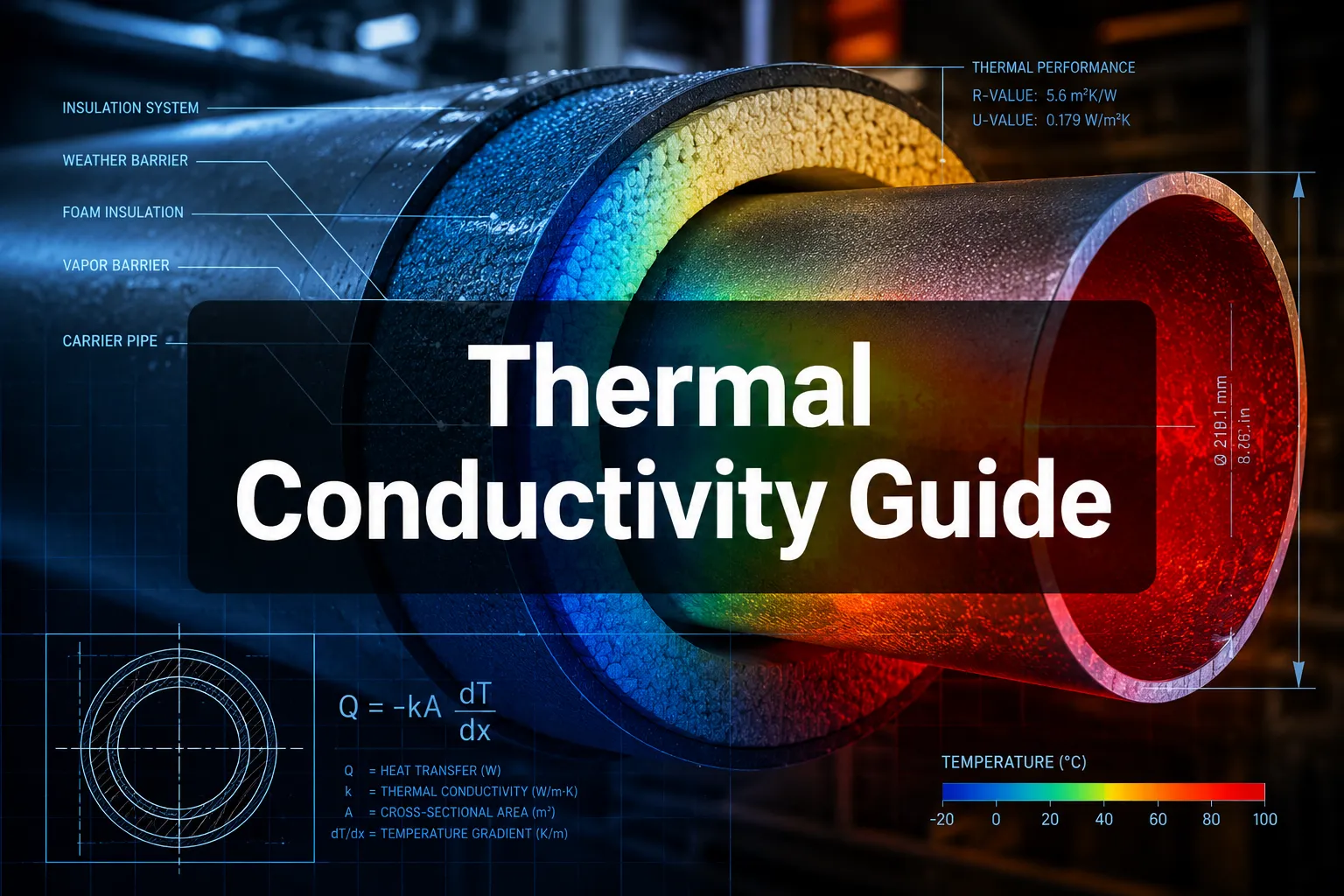
Thermal conductivity measures how quickly heat moves through a material, expressed in watts per meter-kelvin (W/mK). For pipe insulation foam, this property determines how effectively the material prevents unwanted heat transfer between the pipe contents and surrounding environment.
Lower thermal conductivity values indicate better insulation performance. A foam with 0.020 W/mK thermal conductivity will prevent heat transfer twice as effectively as one rated at 0.040 W/mK. This difference translates directly into energy savings, temperature maintenance, and system efficiency.
Why thermal conductivity matters for pipe systems:
- Energy efficiency – Better insulation reduces heating and cooling costs by 15-30%
- Temperature control – Maintains desired pipe temperatures with less energy input
- Condensation prevention – Proper insulation prevents moisture buildup on cold pipes
- Freeze protection – Low thermal conductivity helps prevent pipe freezing in cold environments
- Process control – Industrial systems require precise temperature maintenance for optimal operation
The choice of pipe insulation sandwich panel systems often depends on achieving specific thermal conductivity targets for the application.
How Is Thermal Conductivity Measured for Foam Insulation
Thermal conductivity testing follows standardized laboratory methods, primarily ASTM C518 (Heat Flow Meter) and ASTM C177 (Guarded Hot Plate). These tests measure heat flow through a foam sample under controlled temperature conditions to determine the W/mK rating.
Standard testing conditions include:
- Mean temperature of 24°C for baseline measurements
- Sample thickness of 25-50mm depending on foam density
- Steady-state conditions maintained for 2-4 hours
- Calibrated equipment with accuracy within ±2%
Testing variables that affect results:
- Foam age – Newly manufactured foam may show different values than aged samples
- Moisture content – Even small amounts of water significantly increase thermal conductivity
- Temperature range – Values change at different operating temperatures
- Foam density – Higher density generally correlates with lower thermal conductivity
Manufacturers typically report thermal conductivity at 24°C mean temperature, but real-world performance varies based on actual operating conditions. For critical applications, request test data at expected service temperatures.
What's the Difference Between Thermal Conductivity and R-Value
R-value represents thermal resistance while thermal conductivity measures heat transfer rate – they are mathematical inverses of each other. R-value equals material thickness divided by thermal conductivity (R = t/k), making it easier to compare insulation effectiveness across different thicknesses.
Key differences explained:
- Thermal conductivity (k-value) – Material property independent of thickness, measured in W/mK
- R-value – System property that includes thickness, measured in m²K/W
- Higher R-values mean better insulation – Opposite relationship compared to thermal conductivity
- R-value scales with thickness – Double the thickness, double the R-value
Practical example:
A 50mm thick foam with 0.025 W/mK thermal conductivity has an R-value of 2.0 m²K/W (0.05m ÷ 0.025 W/mK = 2.0). The same foam at 100mm thickness would have an R-value of 4.0 m²K/W.
When to use each measurement:
- Use thermal conductivity when comparing different foam materials
- Use R-value when designing systems and calculating required insulation thickness
- Use both for comprehensive performance evaluation
Understanding both values helps make informed decisions about thermal performance sandwich panel systems and insulation specifications.
Which Foam Insulation Has the Best Thermal Conductivity
Closed-cell polyurethane and polyisocyanurate foams offer the best thermal conductivity performance for pipe insulation, typically ranging from 0.020 to 0.025 W/mK. These materials provide superior insulation in compact thicknesses compared to other foam types.
Performance ranking by foam type:
- Polyisocyanurate (PIR) – 0.020-0.022 W/mK, excellent high-temperature performance
- Closed-cell polyurethane – 0.022-0.025 W/mK, versatile temperature range
- Phenolic foam – 0.025-0.030 W/mK, fire-resistant properties
- Expanded polystyrene (EPS) – 0.030-0.038 W/mK, cost-effective option
- Open-cell polyurethane – 0.035-0.040 W/mK, good for moderate applications
Factors affecting foam selection:
- Operating temperature range – PIR handles higher temperatures than standard polyurethane
- Moisture exposure – Closed-cell foams resist water absorption better
- Fire safety requirements – Phenolic foam offers superior fire resistance
- Budget constraints – EPS provides acceptable performance at lower cost
- Installation method – Some foams are easier to cut and fit around complex pipe configurations
Choose closed-cell polyurethane for most applications requiring thermal conductivity below 0.025 W/mK. Consider PIR for high-temperature applications above 120°C where thermal performance is critical.
How Does Temperature Affect Foam Insulation Thermal Conductivity
Thermal conductivity increases with temperature for most foam insulations, meaning insulation performance decreases as operating temperatures rise. This relationship varies by foam type, with some materials maintaining better performance across wider temperature ranges.
Temperature effects by foam type:
- Polyurethane foam – Thermal conductivity increases 15-25% from 0°C to 100°C
- Polyisocyanurate – More stable, only 10-15% increase across same range
- EPS foam – Significant degradation above 70°C, not suitable for hot applications
- Phenolic foam – Maintains properties up to 150°C with minimal increase
Critical temperature thresholds:
- Below -40°C – Most foams become brittle and lose insulating properties
- Above 150°C – Standard foams begin thermal degradation
- Freeze-thaw cycles – Repeated temperature cycling can damage foam structure
- Thermal shock – Rapid temperature changes may cause cracking
Design considerations for temperature effects:
- Specify thermal conductivity at service temperature – Don't rely on 24°C test values
- Add safety factors – Account for temperature variations in system design
- Consider thermal expansion – Foam and pipe expand at different rates
- Plan for aging effects – Performance may degrade over time at extreme temperatures
For applications with wide temperature swings, choose foams with stable thermal conductivity across the expected operating range.
What Thermal Conductivity Do I Need for My Pipes
Required thermal conductivity depends on pipe temperature, ambient conditions, and efficiency targets. Hot water systems typically need thermal conductivity below 0.025 W/mK, while chilled water applications can use materials up to 0.035 W/mK effectively.
Application-specific requirements:
Hot water pipes (60-90°C):
- Thermal conductivity: 0.020-0.025 W/mK
- Minimum thickness: 25-50mm depending on pipe size
- Consider PIR or closed-cell polyurethane
Chilled water pipes (5-15°C):
- Thermal conductivity: 0.025-0.035 W/mK
- Focus on vapor barrier properties
- Standard closed-cell foam acceptable
Steam pipes (100-200°C):
- Thermal conductivity: 0.020-0.022 W/mK maximum
- High-temperature rated materials only
- Thicker insulation required (75-150mm)
Refrigeration pipes (-20 to 5°C):
- Thermal conductivity: 0.020-0.030 W/mK
- Closed-cell foam essential
- Vapor barrier critical
Selection criteria:
- Energy cost analysis – Calculate payback period for higher-performance foam
- Space constraints – Better thermal conductivity allows thinner insulation
- Code requirements – Some jurisdictions specify minimum R-values
- Maintenance access – Consider removable insulation for serviceable pipes
Use online calculators or consult with thermal insulation sandwich panel specialists to determine optimal specifications for your specific application.
Can Thermal Conductivity of Foam Change Over Time
Yes, thermal conductivity of foam insulation can degrade over time due to aging, moisture infiltration, and blowing agent diffusion. Most foams experience 5-15% performance degradation over their first 5-10 years of service life.
Primary aging mechanisms:
- Blowing agent diffusion – Gas cells gradually fill with air, reducing insulating properties
- Moisture absorption – Water infiltration dramatically increases thermal conductivity
- UV degradation – Exposed foam breaks down under sunlight
- Thermal cycling – Repeated heating and cooling stresses foam structure
- Chemical exposure – Aggressive environments can degrade foam chemistry
Degradation rates by foam type:
- Closed-cell polyurethane – 5-10% increase in thermal conductivity over 10 years
- Open-cell foam – 10-20% degradation, highly moisture-sensitive
- EPS foam – Minimal aging effects if protected from moisture
- PIR foam – 3-7% increase, most stable long-term performance
Prevention strategies:
- Proper vapor barriers – Prevent moisture infiltration with sealed jackets
- UV protection – Cover exposed foam with protective cladding
- Quality installation – Eliminate gaps and thermal bridges
- Regular inspection – Monitor for damage, moisture, or compression
- Planned replacement – Budget for insulation renewal every 15-20 years
Signs of thermal conductivity degradation:
- Increased energy consumption with same operating conditions
- Condensation appearing on previously dry surfaces
- Visible moisture stains or mold growth
- Compressed or damaged foam sections
Plan for gradual performance decline when calculating long-term energy savings and system efficiency.
How Much Does High Performance Pipe Insulation Foam Cost
High-performance foam insulation with thermal conductivity below 0.025 W/mK typically costs 2-3 times more than standard options, but provides better long-term value through energy savings. Expect to pay $15-40 per linear meter for quality pipe insulation depending on pipe size and foam specifications.
Cost breakdown by foam type:
- Standard EPS foam – $8-15 per linear meter, 0.035 W/mK thermal conductivity
- Closed-cell polyurethane – $20-35 per linear meter, 0.025 W/mK performance
- PIR foam – $25-40 per linear meter, 0.022 W/mK with high-temperature capability
- Phenolic foam – $30-45 per linear meter, fire-resistant with 0.025 W/mK
Factors affecting cost:
- Pipe diameter – Larger pipes require more material and higher per-meter costs
- Insulation thickness – Thicker foam increases material and labor costs
- Installation complexity – Difficult access areas increase labor charges
- Quantity – Bulk purchases reduce per-unit costs by 15-25%
- Special requirements – Fire rating, chemical resistance, or extreme temperatures add cost
Return on investment calculation:
High-performance foam typically pays for itself within 3-5 years through reduced energy costs. A system saving $500 annually in energy costs justifies spending an extra $1,500-2,500 on better insulation.
Budget planning considerations:
- Initial cost vs. lifecycle value – Better foam reduces long-term operating expenses
- Energy price trends – Rising energy costs improve payback for efficient insulation
- Maintenance costs – Quality insulation requires less frequent replacement
- System downtime – Better insulation reduces maintenance-related shutdowns
Consider total cost of ownership rather than initial purchase price when selecting pipe insulation foam specifications.
What Happens If You Use Low Thermal Conductivity Foam on Hot Pipes
Using foam with inadequate thermal conductivity on hot pipes leads to excessive heat loss, higher energy costs, and potential safety issues. The insulation becomes less effective, requiring more energy to maintain desired pipe temperatures and potentially creating hot surface hazards.
Immediate consequences:
- Increased energy consumption – 20-50% higher heating costs depending on thermal conductivity gap
- Poor temperature control – Difficulty maintaining consistent pipe temperatures
- Hot surface hazards – Exterior surfaces may exceed safe touch temperatures (60°C)
- Accelerated foam degradation – High heat loads cause premature aging and failure
Long-term impacts:
- System inefficiency – Heating equipment works harder, reducing lifespan
- Comfort issues – Inconsistent hot water delivery in building systems
- Code violations – May fail to meet energy efficiency requirements
- Higher maintenance costs – More frequent insulation replacement needed
Performance comparison example:
A 100mm hot water pipe at 80°C with 0.040 W/mK foam loses approximately 45 watts per linear meter. The same pipe with 0.025 W/mK foam loses only 28 watts per linear meter – a 38% reduction in heat loss.
Mitigation strategies:
- Increase insulation thickness – Compensate for poor thermal conductivity with more material
- Add outer insulation layer – Apply high-performance foam over existing insulation
- Replace with appropriate foam – Upgrade to foam rated for the temperature and performance requirements
- Improve system controls – Better temperature control can partially offset insulation deficiencies
Always match foam thermal conductivity specifications to actual system requirements rather than accepting generic insulation solutions.
Is Thermal Conductivity the Only Thing That Matters When Choosing Pipe Foam
No, thermal conductivity is just one of several critical factors when selecting pipe insulation foam. Fire resistance, moisture resistance, temperature limits, and installation requirements often carry equal or greater importance depending on the application.
Other essential properties:
Fire safety characteristics:
- Flame spread rating and smoke development
- Self-extinguishing properties
- Toxic gas emission during combustion
- Compliance with building codes
Moisture resistance:
- Water absorption rates
- Vapor permeability
- Closed-cell vs. open-cell structure
- Long-term performance in humid conditions
Mechanical properties:
- Compressive strength for load-bearing applications
- Flexibility for thermal expansion accommodation
- Durability under vibration or movement
- Resistance to crushing during installation
Chemical compatibility:
- Resistance to pipe materials and coatings
- Compatibility with cleaning chemicals
- UV stability for outdoor applications
- Resistance to oils, solvents, or process chemicals
Installation considerations:
- Ease of cutting and fitting around complex pipe configurations
- Adhesive requirements for secure attachment
- Vapor barrier integration for moisture-sensitive applications
- Removability for maintenance access
- Available sizes and shapes to minimize waste and labor
Decision matrix approach:
Rank all requirements by importance for your specific application. Thermal conductivity might be the top priority for energy-critical systems, but fire safety could be paramount in occupied buildings, while moisture resistance dominates in outdoor or high-humidity environments.
Consider the complete performance profile rather than optimizing for thermal conductivity alone.
What's the Best Foam Insulation for Freezing Temperatures
Closed-cell polyurethane foam with thermal conductivity around 0.022-0.025 W/mK performs best in freezing conditions because it resists moisture infiltration and maintains insulating properties at low temperatures. The closed-cell structure prevents ice formation within the foam that would destroy its thermal performance.
Key requirements for freezing applications:
- Closed-cell structure – Essential to prevent moisture absorption and ice formation
- Low-temperature flexibility – Foam must remain flexible to -40°C without cracking
- Vapor barrier properties – Prevent moisture migration that leads to ice buildup
- Thermal stability – Maintain insulating properties across freeze-thaw cycles
Recommended foam specifications:
Primary choice: Closed-cell polyurethane
- Thermal conductivity: 0.022-0.025 W/mK
- Service temperature: -50°C to +100°C
- Water absorption: <2% by volume
- Vapor permeability: <0.5 perm-inch
Alternative: PIR foam for extreme conditions
- Thermal conductivity: 0.020-0.022 W/mK
- Enhanced low-temperature performance
- Higher cost but superior long-term durability
Installation considerations for freezing environments:
- Continuous vapor barrier – Seal all joints and penetrations
- Adequate thickness – Use 25-50mm minimum thickness depending on pipe size
- Thermal bridging prevention – Avoid metal fasteners that conduct cold
- Expansion joints – Allow for thermal movement without cracking insulation
- Protective jacketing – Shield foam from physical damage and UV exposure
Common mistakes in freezing applications:
- Using open-cell foam that absorbs moisture and fails when frozen
- Inadequate vapor barrier allowing moisture infiltration
- Insufficient thickness for extreme temperature conditions
- Poor joint sealing creating thermal bridges and condensation points
For critical freeze protection, consider energy efficient sandwich panel systems that provide integrated thermal and vapor barriers.
How Do You Test Thermal Conductivity of Pipe Insulation On Site
Field testing of thermal conductivity requires specialized equipment and is typically limited to comparative measurements rather than precise laboratory-grade results. Most on-site testing focuses on thermal performance verification and identifying insulation defects rather than measuring exact thermal conductivity values.
Available field testing methods:
Infrared thermography:
- Identifies hot spots and thermal bridges
- Compares surface temperatures across insulated surfaces
- Detects moisture infiltration and damaged insulation
- Cannot provide precise thermal conductivity values
Heat flux meters:
- Measure actual heat loss through insulation
- Provide real-world performance data
- Require steady-state conditions for accurate readings
- More practical than thermal conductivity measurement
Temperature differential measurement:
- Monitor pipe temperature vs. surface temperature
- Calculate approximate thermal resistance
- Simple method using standard thermometers
- Useful for performance verification
Practical on-site testing approach:
- Establish baseline conditions – Ensure steady-state operation for 2-4 hours
- Measure key temperatures – Pipe surface, insulation surface, and ambient air
- Document system parameters – Flow rates, operating pressures, weather conditions
- Compare to design calculations – Verify performance meets specifications
- Identify problem areas – Use infrared imaging to locate defects
Limitations of field testing:
- Environmental variables – Wind, humidity, and ambient temperature affect results
- Equipment accuracy – Field instruments less precise than laboratory equipment
- Access constraints – Difficult to test insulation in confined spaces
- Time requirements – Steady-state conditions needed for reliable measurements
When to conduct field testing:
- Commissioning new systems – Verify insulation performance meets design requirements
- Energy audits – Identify opportunities for insulation improvements
- Troubleshooting – Investigate unexpected energy consumption or temperature control issues
- Maintenance planning – Assess insulation condition and replacement needs
For precise thermal conductivity values, send samples to certified laboratories following ASTM C518 or C177 test methods.
Does Foam Insulation Thermal Conductivity Degrade When Wet
Yes, moisture dramatically increases thermal conductivity of foam insulation, with wet foam losing 50-80% of its insulating effectiveness depending on foam type and water content. Water has thermal conductivity of 0.6 W/mK compared to air at 0.025 W/mK, making wet insulation nearly useless.
Moisture effects by foam type:
Open-cell polyurethane:
- Absorbs 10-20% water by volume when saturated
- Thermal conductivity increases from 0.035 to 0.15+ W/mK when wet
- Extremely vulnerable to moisture damage
Closed-cell polyurethane:
- Absorbs <2% water by volume under normal conditions
- Thermal conductivity increases 20-40% when moisture infiltrates
- Better moisture resistance but still vulnerable to vapor infiltration
EPS foam:
- Water absorption varies by density (2-4% by volume)
- Performance degradation proportional to moisture content
- Retains some insulating value even when damp
PIR foam:
- Excellent moisture resistance when properly installed
- <1% water absorption by volume
- Minimal thermal conductivity increase unless vapor barrier fails
Moisture infiltration mechanisms:
- Vapor diffusion – Gradual moisture migration through foam structure
- Air leakage – Humid air carrying moisture into insulation
- Condensation – Temperature differences causing water formation within foam
- Direct water contact – Leaks, flooding, or poor drainage
- Installation damage – Cuts or punctures in vapor barriers
Prevention strategies:
- Continuous vapor barriers – Sealed plastic or foil facings on all surfaces
- Proper joint sealing – Use compatible tapes and sealants at all connections
- Drainage design – Prevent water accumulation around insulated pipes
- Regular inspection – Monitor for signs of moisture infiltration
- Quality installation – Train installers on proper moisture protection techniques
Signs of moisture problems:
- Visible water stains or discoloration on insulation surfaces
- Mold or mildew growth on foam or jacketing materials
- Increased energy consumption without other system changes
- Condensation on surfaces that were previously dry
- Musty odors around insulated equipment
Address moisture issues immediately, as wet insulation rarely recovers its original thermal performance even after drying.
Frequently Asked Questions
What is considered good thermal conductivity for pipe insulation foam?
Good thermal conductivity for pipe insulation foam is 0.025 W/mK or lower. Premium foams achieve 0.020-0.022 W/mK, while acceptable performance ranges from 0.025-0.030 W/mK. Values above 0.035 W/mK indicate poor insulating performance.
How thick should pipe insulation be for different thermal conductivity values?
Thickness depends on pipe size and thermal conductivity. For 50mm pipes, use 25mm thickness with 0.022 W/mK foam, 35mm with 0.025 W/mK foam, or 50mm with 0.035 W/mK foam to achieve similar thermal performance.
Can you improve thermal conductivity of existing foam insulation?
You cannot improve the thermal conductivity of existing foam, but you can add additional insulation layers, seal air gaps, or install reflective barriers to improve overall system thermal performance.
Does foam density affect thermal conductivity?
Yes, higher density foam generally has lower thermal conductivity up to an optimal point. Beyond that point, increased density can actually increase thermal conductivity as solid material displaces insulating air pockets.
How do you calculate heat loss with known thermal conductivity?
Heat loss equals thermal conductivity times surface area times temperature difference, divided by insulation thickness (Q = k × A × ΔT / t). This formula helps determine energy savings from different foam specifications.
What thermal conductivity is required for condensation prevention?
Condensation prevention requires thermal conductivity low enough to keep surface temperature above dew point. This typically means 0.025-0.030 W/mK maximum for most chilled water applications in normal indoor conditions.
How long does foam insulation maintain its thermal conductivity?
Quality closed-cell foam maintains 90-95% of original thermal conductivity for 15-20 years when properly installed and protected from moisture. Open-cell foam degrades faster, especially in humid conditions.
Does pipe insulation foam thermal conductivity vary by manufacturer?
Yes, thermal conductivity can vary 10-20% between manufacturers for the same foam type due to formulation differences, manufacturing processes, and quality control standards. Always verify specifications with test data.
What happens to thermal conductivity at very high temperatures?
Thermal conductivity increases with temperature, and foam may degrade or melt at extreme temperatures. Standard polyurethane foam loses effectiveness above 100°C, while PIR foam maintains properties to 150°C.
Is there a minimum thermal conductivity achievable with foam insulation?
Current foam technology achieves thermal conductivity as low as 0.018-0.020 W/mK. Further improvements are limited by the thermal conductivity of air itself (0.025 W/mK) and the need for structural foam material.
How do you specify thermal conductivity requirements for contractors?
Specify thermal conductivity at service temperature, not just standard test conditions. Include requirements for testing documentation, installation standards, and vapor barrier specifications to ensure performance.
Can thermal conductivity testing be done on installed insulation?
Direct thermal conductivity testing on installed insulation is impractical. Instead, use thermal imaging, heat flux measurements, and temperature monitoring to verify thermal performance of installed systems.
Conclusion
Understanding the thermal conductivity of pipe insulation foam is essential for designing efficient piping systems that minimize energy loss and maintain optimal operating temperatures. The best performing foams achieve thermal conductivity values of 0.020-0.025 W/mK, with closed-cell polyurethane and PIR foams leading the market for most applications.
Key selection criteria include matching thermal conductivity to your specific temperature requirements, considering moisture resistance and fire safety properties, and evaluating long-term performance stability. While high-performance foams cost more initially, they typically provide superior value through reduced energy consumption and longer service life.
Take these next steps to optimize your pipe insulation:
- Calculate your thermal requirements based on operating temperatures and efficiency targets
- Compare lifecycle costs rather than focusing solely on initial material prices
- Specify proper installation standards including vapor barriers and joint sealing
- Plan regular inspections to identify moisture infiltration or performance degradation
- Consider system-wide solutions like pipe insulation sandwich panels for complex installations
For critical applications, consult with insulation specialists who can provide detailed thermal analysis and recommend optimal foam specifications for your specific operating conditions and performance requirements.
SEO Meta Title: Thermal Conductivity of Pipe Insulation Foam: 2026 Guide