Last updated: July 31, 2026

Quick Answer: A cold room sandwich panel is a three-layer insulated construction material consisting of two metal facings (typically steel or aluminum) bonded to a high-performance insulation core (usually polyurethane foam or polystyrene). These panels provide superior thermal insulation, structural strength, and moisture resistance for temperature-controlled environments like cold storage facilities, food processing plants, and pharmaceutical warehouses.
Key Takeaways
- Cold room sandwich panels combine two metal sheets with an insulation core for maximum thermal efficiency
- Polyurethane (PU) cores offer the best insulation performance with R-values of 6-8 per inch
- Panel thickness ranges from 50mm to 200mm depending on temperature requirements and structural loads
- Installation costs vary from $15-45 per square meter including materials and labor
- Fire ratings must meet local building codes, with Class A fire-resistant options available
- Lifespan typically exceeds 20-25 years with proper maintenance and quality materials
- Moisture resistance prevents condensation and mold growth in high-humidity environments
- Energy savings can reduce cooling costs by 30-50% compared to traditional insulation methods
What Is a Cold Room Sandwich Panel and How Does It Work
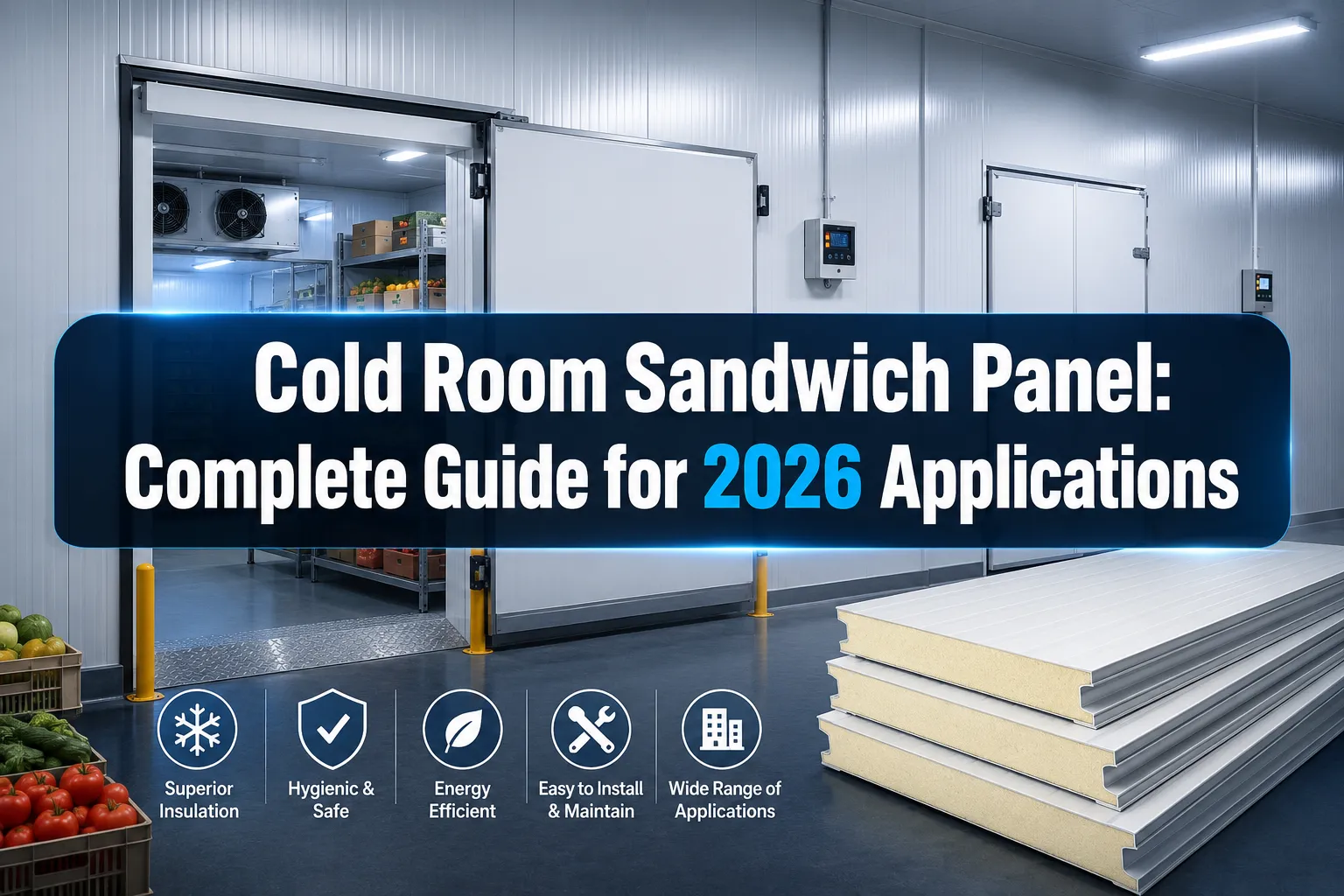
A cold room sandwich panel is a prefabricated insulated building component that creates an effective thermal barrier for temperature-controlled spaces. The panel works by trapping air within its insulation core while the metal facings provide structural integrity and protect against moisture infiltration.
The three-layer construction includes:
- Outer facing: Weather-resistant metal skin (steel, aluminum, or stainless steel)
- Insulation core: High-density foam (polyurethane, polystyrene, or polyisocyanurate)
- Inner facing: Food-grade or cleanroom-compatible metal surface
Thermal performance occurs through the insulation core's cellular structure, which minimizes heat transfer through conduction, convection, and radiation. The continuous insulation eliminates thermal bridging that occurs with traditional framing methods.
Vapor barriers integrated into the panel design prevent moisture migration that could compromise insulation performance or create condensation problems. This makes cold room sandwich panels particularly effective in environments with significant temperature differentials.
Who Needs Cold Room Sandwich Panels and What Are They Used For
Food industry businesses represent the largest user group for cold room sandwich panels, including restaurants, grocery stores, meat processing facilities, and dairy operations that require consistent temperature control for food safety compliance.
Pharmaceutical companies use these panels for temperature-sensitive medication storage, vaccine cold chains, and research facilities where precise environmental control is critical for product integrity.
Industrial applications include:
- Cold storage warehouses and distribution centers
- Ice cream manufacturing facilities
- Brewery fermentation rooms
- Chemical storage requiring temperature stability
- Data centers needing thermal management
Agricultural operations benefit from cold room panels in produce storage facilities, flower preservation rooms, and seed storage buildings where temperature and humidity control directly impact product quality and shelf life.
Choose cold room sandwich panels when your application requires temperatures below 50°F (10°C), involves high humidity conditions, or demands rapid temperature recovery after door openings. Avoid them for applications with frequent structural modifications or where panel replacement would be extremely difficult.
Cold Room Sandwich Panel vs Regular Insulation: Which Is Better
Cold room sandwich panels outperform regular insulation in thermal efficiency, installation speed, and long-term durability for temperature-controlled applications. Traditional insulation systems typically achieve R-13 to R-19 values, while sandwich panels deliver R-30 to R-50 performance in the same wall thickness.
Installation advantages of sandwich panels include:
- 50-70% faster installation compared to stick-built insulated walls
- Integrated vapor barrier eliminates separate membrane installation
- Structural support reduces need for additional framing
- Consistent thickness prevents thermal bridging common in traditional construction
Cost comparison shows sandwich panels cost 15-25% more initially but provide 20-30% energy savings annually. The break-even point typically occurs within 3-4 years for commercial cold storage applications.
Regular insulation works better when building codes require specific framing systems, when panels cannot accommodate complex architectural features, or when future modifications are likely. Traditional systems also offer more flexibility for electrical and plumbing integration during construction.
For more information on specific panel types, see our PU sandwich panel for cold room guide.
How Much Does a Cold Room Sandwich Panel Cost
Cold room sandwich panel costs range from $12-35 per square meter for materials, with total installed costs reaching $25-55 per square meter depending on panel specifications, project size, and regional labor rates.
Price factors include:
- Panel thickness: 75mm panels cost 40% less than 150mm panels
- Core material: PU foam costs 20-30% more than EPS but offers superior insulation
- Facing material: Stainless steel facings add $8-12 per square meter over galvanized steel
- Fire rating: Class A fire-resistant panels increase costs by 15-25%
Project size impact:
- Small projects (under 500 sq m): $45-55 per sq m installed
- Medium projects (500-2000 sq m): $35-45 per sq m installed
- Large projects (over 2000 sq m): $25-35 per sq m installed
Additional costs include structural supports ($5-8 per sq m), door and window integration ($200-500 per opening), and electrical penetration sealing ($50-100 per penetration).
Budget 10-15% extra for waste, cutting, and installation complexities. Projects requiring custom panel sizes or special coatings can increase costs by 20-40%.
For detailed pricing information, check our sandwich panel price guide for Bangladesh.
How Thick Should a Cold Room Sandwich Panel Be
Panel thickness selection depends on the target temperature, energy efficiency goals, and structural load requirements. Standard thicknesses range from 50mm to 200mm, with 100-150mm being most common for commercial cold storage applications.
Temperature-based thickness guidelines:
- Above 32°F (0°C): 75-100mm panels provide adequate insulation
- 0°F to 32°F (-18°C to 0°C): 100-150mm panels recommended for efficiency
- Below 0°F (-18°C): 150-200mm panels necessary for deep freeze applications
- Ultra-low temperature (-40°F/-40°C): 200mm+ panels with specialized cores required
Energy efficiency considerations show that increasing panel thickness from 100mm to 150mm reduces heat transfer by 35-40% but increases material costs by only 25-30%. This makes thicker panels cost-effective for facilities with high energy costs or continuous operation.
Structural requirements may dictate minimum thickness for wind loads, seismic forces, or equipment mounting. Panels supporting overhead equipment typically require 100mm minimum thickness regardless of thermal requirements.
Common mistake: Choosing panels too thin to meet local energy codes. Always verify thickness requirements with building officials before ordering materials.
For specific thickness recommendations, see our guide on choosing sandwich panel thickness.
Cold Room Sandwich Panel Installation Problems and Solutions
Thermal bridging represents the most common installation problem, occurring when metal fasteners or structural elements create heat transfer paths through the insulation. This reduces panel efficiency by 15-25% and can cause condensation problems.
Solution: Use thermal break fasteners, minimize penetrations, and seal all joints with appropriate sealants designed for temperature cycling.
Panel alignment issues arise when panels don't fit properly due to building tolerances or measurement errors. Gaps larger than 6mm significantly compromise thermal performance and allow air infiltration.
Prevention steps:
- Verify building dimensions before panel fabrication
- Use laser levels for accurate panel positioning
- Install panels in proper sequence (bottom to top, corner to corner)
- Check alignment after every 3-4 panels
Condensation problems occur when vapor barriers are compromised or panels lack proper edge sealing. This leads to insulation degradation and potential mold growth.
Solutions include using continuous vapor barrier tape at all joints, installing proper ventilation systems, and maintaining consistent temperature gradients across panel thickness.
Fastener failure happens when installers use incorrect fasteners for panel thickness or substrate material. This creates structural weakness and potential panel detachment.
Best practices: Use manufacturer-specified fasteners, maintain proper fastener spacing (typically 12-18 inches on center), and apply appropriate torque values to prevent over-compression.
For professional installation services, see our sandwich panel installation guide.
Cold Room Sandwich Panel Fire Rating Requirements
Fire ratings for cold room sandwich panels must comply with local building codes, which typically require Class A (flame spread index 0-25) or Class B (flame spread index 26-75) ratings for commercial food storage facilities.
Core material fire performance:
- Polyurethane foam: Achieves Class A ratings with fire retardant additives
- Polyisocyanurate: Naturally flame-resistant, meets Class A without additives
- Polystyrene (EPS): Typically achieves Class B ratings, requires fire barriers in some applications
Testing standards include ASTM E84 (Steiner Tunnel Test) for surface burning characteristics and ASTM E119 for fire resistance ratings. Panels must maintain structural integrity for specified time periods during fire exposure.
Code compliance requirements:
- Sprinkler systems may allow reduced fire ratings in some jurisdictions
- Occupancy classification affects minimum fire rating requirements
- Building height and area limitations may require higher fire ratings
Fire barrier installation becomes necessary when panels don't meet code requirements independently. This typically adds $3-5 per square meter to installation costs but ensures compliance.
Documentation requirements include fire test certificates from accredited laboratories and installation certification from qualified contractors. Keep these documents for insurance and inspection purposes.
For fire-rated options, see our fire rated sandwich panel guide.
Best Cold Room Sandwich Panel Brands and Alternatives
Leading manufacturers produce panels meeting international quality standards, with performance differences primarily in core density, facing materials, and manufacturing tolerances.
Quality indicators to evaluate include:
- Core density consistency (±5% variation or less)
- Adhesion strength between facings and core (minimum 0.1 MPa)
- Thermal conductivity values verified by independent testing
- Dimensional tolerances within ±2mm for length and width
Alternative solutions for specific applications:
Spray foam insulation costs 20-30% less initially but requires skilled application and separate vapor barriers. Best for irregular shapes or retrofit applications.
Vacuum insulated panels (VIPs) provide superior thermal performance in minimal thickness but cost 3-5 times more than sandwich panels. Suitable for space-constrained applications with extreme temperature requirements.
Structural insulated panels (SIPs) offer integrated structural and thermal performance but typically don't achieve the R-values needed for cold storage applications.
Selection criteria should prioritize thermal performance over initial cost for facilities with continuous operation. Calculate total cost of ownership including energy costs over the panel's expected 20-25 year lifespan.
Avoid panels with recycled foam cores, inadequate quality certifications, or manufacturers without established service networks in your region.
Do Cold Room Sandwich Panels Need Maintenance
Cold room sandwich panels require minimal maintenance when properly installed, but regular inspections prevent small issues from becoming costly problems. Well-maintained panels can exceed their 20-25 year design life by 5-10 years.
Monthly inspection tasks include:
- Visual examination of panel joints for gaps or sealant deterioration
- Surface cleaning with appropriate cleaners for food-grade environments
- Fastener inspection for loose or corroded connections
- Drainage system checks to prevent water accumulation
Annual maintenance requirements:
- Sealant replacement at joints showing cracking or shrinkage
- Fastener retorquing to manufacturer specifications
- Thermal imaging to identify insulation degradation or air leaks
- Door seal inspection and replacement as needed
Cleaning protocols vary by application. Food storage facilities require FDA-approved cleaners and sanitizers, while pharmaceutical applications may need validated cleaning procedures for regulatory compliance.
Common maintenance issues include sealant failure (typically after 7-10 years), surface scratches that compromise protective coatings, and fastener corrosion in high-humidity environments.
Preventive measures include using stainless steel fasteners in corrosive environments, applying protective films during construction, and maintaining proper ventilation to control humidity levels.
Professional maintenance should be performed every 3-5 years by qualified technicians who can identify structural issues and perform thermal performance testing.
How Long Do Cold Room Sandwich Panels Last
Cold room sandwich panels typically last 20-25 years under normal operating conditions, with some high-quality installations exceeding 30 years when properly maintained. Panel lifespan depends on environmental conditions, maintenance quality, and initial installation standards.
Factors affecting longevity:
- Temperature cycling: Frequent temperature changes reduce lifespan by 10-15%
- Humidity exposure: High humidity accelerates sealant degradation and metal corrosion
- Chemical exposure: Cleaning agents and process chemicals can degrade panel surfaces
- Physical damage: Impact damage and vibration affect structural integrity
Core material durability:
- Polyurethane foam: Maintains 90%+ insulation value for 20+ years
- Polystyrene: May show 10-15% degradation after 15-20 years
- Polyisocyanurate: Excellent long-term stability, often exceeds 25 years
End-of-life indicators include visible core degradation, significant thermal performance loss (measured by increased energy consumption), structural damage that cannot be economically repaired, or failure to meet updated building codes.
Replacement planning should begin when panels show 20%+ thermal performance degradation or require frequent repairs. Partial replacement is often possible, allowing phased upgrades without complete facility shutdown.
Warranty coverage typically includes 10-15 years for thermal performance and 5-10 years for structural integrity. Extended warranties are available for premium panels and may be cost-effective for critical applications.
Cold Room Sandwich Panel vs Polyurethane Foam: Which Is Cheaper
Sandwich panels cost 15-25% more initially than site-applied polyurethane foam insulation, but provide better long-term value through reduced installation time, superior performance consistency, and lower maintenance requirements.
Cost breakdown comparison (per square meter):
- Sandwich panels: $25-35 materials + $10-15 installation = $35-50 total
- Spray foam: $18-28 materials + $12-18 installation + $3-5 vapor barrier = $33-51 total
Performance differences:
- Thermal consistency: Sandwich panels provide uniform R-values; spray foam varies with application thickness
- Air sealing: Both provide excellent air barriers when properly installed
- Moisture control: Sandwich panels include integrated vapor barriers; spray foam requires separate moisture management
Installation speed favors sandwich panels significantly. A typical cold room installation takes 2-3 days with panels versus 5-7 days with spray foam, reducing labor costs and facility downtime.
Long-term costs favor sandwich panels due to:
- Lower maintenance requirements (no recoating needed)
- Predictable performance degradation over time
- Easier repair and replacement of damaged sections
Choose spray foam when building geometry makes panel installation difficult, when future modifications are planned, or when initial budget constraints are critical. Choose sandwich panels for new construction, large areas, or applications requiring maximum thermal performance and durability.
For detailed comparisons, see our PU panel cold storage guide.
Can You Use Cold Room Sandwich Panels in Humid Environments
Cold room sandwich panels perform excellently in humid environments when properly designed with appropriate vapor barriers and edge sealing systems. The integrated construction prevents moisture infiltration that commonly occurs with traditional insulation systems.
Humidity tolerance depends on panel design and installation quality:
- Standard panels: Handle up to 80% relative humidity with proper sealing
- Enhanced vapor barrier panels: Suitable for 90%+ humidity environments
- Marine-grade panels: Designed for constant high humidity and salt exposure
Critical design features for humid environments include:
- Continuous vapor barriers with sealed joints at all panel connections
- Stainless steel facings or enhanced protective coatings to prevent corrosion
- Closed-cell foam cores that don't absorb moisture if breached
- Proper drainage systems to handle condensation
Installation requirements become more stringent in humid conditions. All panel joints must be sealed with vapor-impermeable sealants, and penetrations require special attention to prevent moisture entry.
Ventilation systems should maintain slight positive pressure inside cold rooms to prevent humid air infiltration. Dehumidification may be necessary when outside humidity exceeds 85% regularly.
Common problems in humid environments include condensation on panel surfaces, sealant failure due to thermal cycling, and corrosion of fasteners and structural supports. These issues are preventable with proper design and materials selection.
Maintenance frequency increases in humid environments, with monthly inspections recommended versus quarterly inspections in dry climates.
For humid climate applications, see our thermal insulation sandwich panel guide.
Common Mistakes When Installing Cold Room Sandwich Panels
Inadequate structural support represents the most costly installation mistake. Panels require proper framing and support systems designed for both dead loads and thermal expansion forces. Undersized supports can cause panel sagging, joint failure, and thermal bridging.
Incorrect panel orientation occurs when installers don't follow manufacturer specifications for panel positioning. Installing panels upside down or backwards can compromise drainage, create vapor barrier discontinuities, and affect structural performance.
Poor joint sealing allows air and moisture infiltration that significantly reduces thermal performance. Common sealing errors include:
- Using inappropriate sealants not designed for temperature cycling
- Insufficient sealant coverage at panel edges
- Failing to prime surfaces before sealant application
- Not maintaining continuous seal lines at corners and penetrations
Thermal bridging through fasteners happens when installers use standard fasteners instead of thermal break versions. This creates heat transfer paths that can reduce insulation effectiveness by 15-20%.
Inadequate edge protection during installation leads to damaged panel cores, compromised vapor barriers, and reduced structural integrity. Always use edge guards and handle panels with appropriate equipment.
Penetration sealing failures occur at electrical, plumbing, and HVAC penetrations. Each penetration requires proper sealing systems designed for the specific utility type and panel thickness.
Prevention strategies include thorough installer training, detailed installation drawings, quality control inspections at each phase, and using only manufacturer-approved materials and methods.
For professional installation, consider our installation services.
FAQ
What is the R-value of cold room sandwich panels?
Cold room sandwich panels typically achieve R-values of 6-8 per inch of thickness, with 100mm (4-inch) panels providing R-24 to R-32 thermal resistance. Polyurethane foam cores offer the highest R-values, while polystyrene cores provide slightly lower but still excellent thermal performance.
How do you cut cold room sandwich panels?
Cut panels using a fine-tooth circular saw blade or panel-specific cutting tools. Make cuts from the finished side to prevent chipping, support both sides of the cut, and seal cut edges immediately with appropriate vapor barrier tape to prevent moisture infiltration into the core.
Can cold room panels be used for walls and ceilings?
Yes, cold room sandwich panels work for both walls and ceilings when properly supported. Ceiling installations require additional structural support due to gravity loads and may need thicker panels (minimum 100mm) to prevent sagging over typical span distances.
What's the difference between PU and EPS sandwich panels?
PU (polyurethane) panels offer superior insulation (R-6 to R-8 per inch) and better moisture resistance but cost 20-30% more. EPS (polystyrene) panels provide good insulation (R-4 to R-5 per inch) at lower cost but may absorb moisture if the vapor barrier is compromised.
Do cold room panels need special fasteners?
Yes, use thermal break fasteners designed for sandwich panel installation. Standard fasteners create thermal bridges that reduce insulation effectiveness. Stainless steel fasteners are recommended for humid or corrosive environments to prevent rust and structural failure.
How do you repair damaged cold room panels?
Small damages can be repaired with appropriate sealants and patches. Larger damages typically require panel replacement. Always seal any core exposure immediately to prevent moisture infiltration and insulation degradation.
What building codes apply to cold room sandwich panels?
Cold room panels must meet local building codes for fire ratings, structural loads, and energy efficiency. Most commercial applications require Class A or B fire ratings and compliance with commercial energy codes. Check with local building officials before installation.
Can you paint cold room sandwich panels?
Yes, but use paints compatible with the panel facing material and intended environment. Food-grade facilities require FDA-approved coatings. Clean surfaces thoroughly and use appropriate primers for best adhesion and longevity.
How much weight can cold room panels support?
Weight capacity depends on panel thickness, span distance, and support structure. Typical 100mm panels can support 50-75 pounds per square foot when properly supported. Consult structural engineers for equipment mounting or heavy load applications.
What's the minimum temperature rating for cold room panels?
Most standard cold room panels handle temperatures down to -20°F (-29°C). Special low-temperature panels with enhanced cores and sealants can operate at -40°F (-40°C) or lower. Verify temperature ratings with manufacturers for specific applications.
How do you clean cold room sandwich panels?
Use mild detergents and soft brushes or cloths. Avoid abrasive cleaners that can damage protective coatings. Food storage facilities should use FDA-approved sanitizers. Rinse thoroughly and ensure complete drying to prevent moisture accumulation.
Can cold room panels be recycled?
Metal facings are fully recyclable, but foam cores present challenges. Some manufacturers offer take-back programs for end-of-life panels. Proper disposal methods vary by location and core material type – consult local waste management authorities for guidance.
Conclusion
Cold room sandwich panels provide the most effective solution for temperature-controlled construction applications in 2026, combining superior thermal performance, structural integrity, and long-term durability in a single building component. With proper selection, installation, and maintenance, these panels deliver 20-25 years of reliable service while reducing energy costs by 30-50% compared to traditional insulation methods.
Key selection factors include matching panel thickness to temperature requirements, choosing appropriate core materials for your specific environment, and ensuring compliance with local building codes and fire safety requirements. The initial investment premium of 15-25% over conventional insulation typically pays back within 3-4 years through energy savings alone.
Next steps for implementing cold room sandwich panels include conducting a thermal analysis of your specific requirements, obtaining quotes from qualified manufacturers, and engaging experienced installers familiar with proper sealing and support techniques. Consider consulting with refrigeration engineers to optimize panel specifications for your cooling system design.
For comprehensive project planning, review our complete guide to building cold rooms and explore our cold storage panel options to make informed decisions for your temperature-controlled facility needs.
SEO Meta Title: Cold Room Sandwich Panel Guide: Complete 2026 Buyer's Guide