Last updated: July 31, 2026

Quick Answer
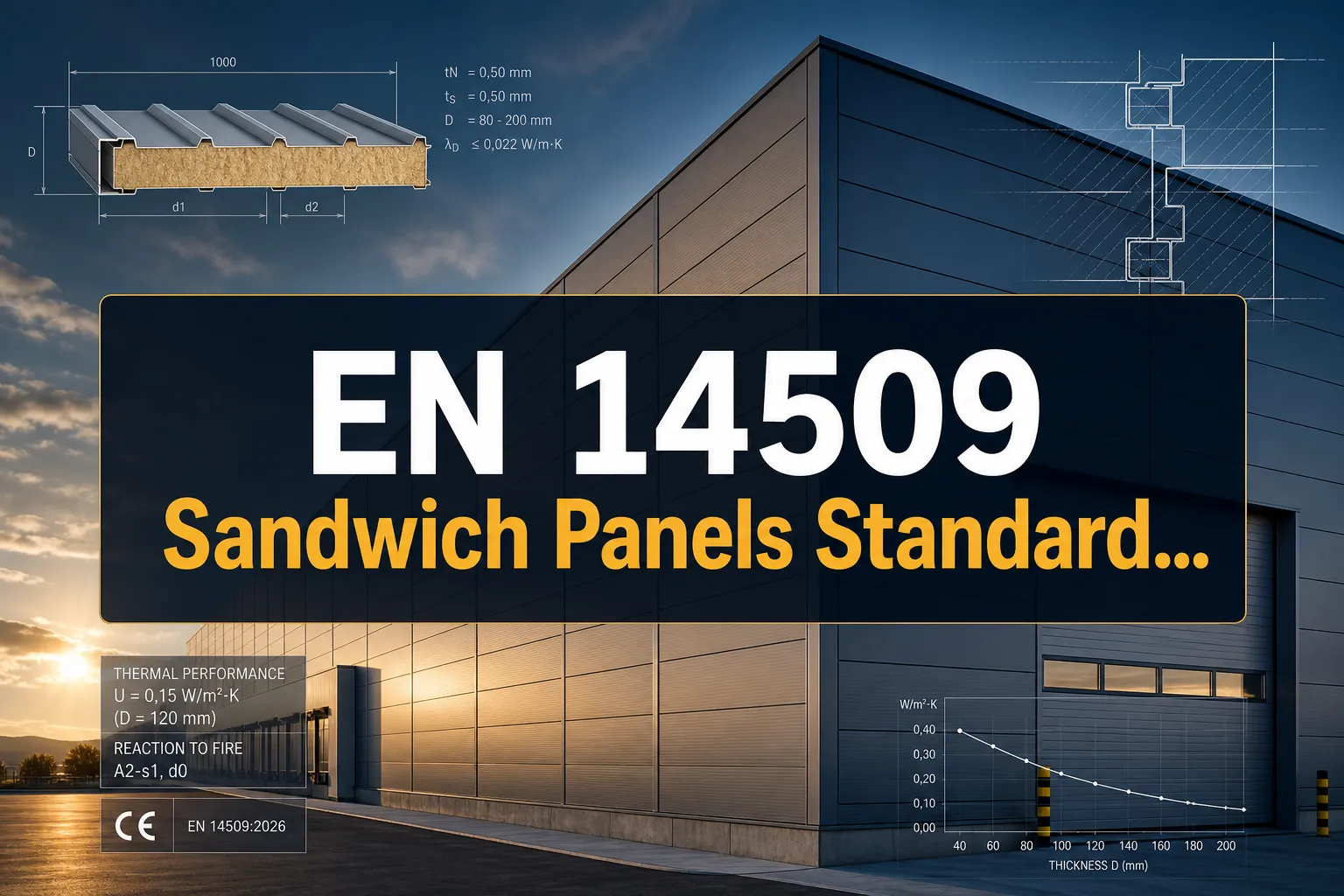
The EN 14509 sandwich panels standard is a European technical specification that defines requirements for self-supporting double skin metal faced insulating panels used in building construction. This standard covers thermal performance, structural capacity, fire resistance, and durability testing for sandwich panels with metal facings and insulating cores like polyurethane, polyisocyanurate, or mineral wool.
Key Takeaways
- EN 14509 establishes comprehensive testing and performance criteria for metal-faced sandwich panels used in construction
- The standard covers thermal insulation, structural load capacity, fire performance, and weather resistance requirements
- Panels must undergo rigorous testing including thermal cycling, water penetration, and structural load tests to achieve certification
- Fire ratings under EN 14509 range from A1 (non-combustible) to F, with most quality panels achieving B or better ratings
- Thermal performance requirements specify minimum R-values and maximum thermal bridging coefficients
- The standard applies to both wall and roof applications in commercial, industrial, and some residential buildings
- Certification involves third-party testing laboratories and ongoing quality control monitoring
- Compliance with EN 14509 is mandatory for CE marking in European markets and increasingly required globally
- Common thickness options range from 40mm to 200mm depending on thermal and structural requirements
- Proper installation following manufacturer guidelines is essential for maintaining EN 14509 compliance
What Is EN 14509 Sandwich Panels Standard
EN 14509 is the European standard that specifies requirements and test methods for self-supporting double skin metal faced insulating panels intended for discontinuous laying as opaque part of roofs, external walls, or internal walls in buildings. The standard was developed by the European Committee for Standardization (CEN) and provides a comprehensive framework for evaluating sandwich panel performance.
The standard applies specifically to panels with metal facings bonded to an insulating core material. Common core materials include expanded polystyrene (EPS), polyurethane (PU), polyisocyanurate (PIR), and mineral wool. The metal facings are typically made from galvanized steel, aluminum, or other corrosion-resistant metals with protective coatings.
Key components covered by EN 14509 include:
- Dimensional tolerances and geometric requirements
- Mechanical and structural performance criteria
- Thermal insulation properties and testing methods
- Fire behavior classification and testing procedures
- Durability and weather resistance requirements
- Quality control and factory production control systems
The standard ensures that sandwich panels meet consistent performance criteria across different manufacturers and applications. This harmonization enables architects, engineers, and contractors to specify panels with confidence in their performance characteristics.
EN 14509 Requirements and Specifications
EN 14509 establishes detailed technical requirements that sandwich panels must meet to achieve certification. These requirements cover multiple performance aspects critical for building applications.
Structural Performance Requirements:
- Minimum bending strength values for different span lengths and loading conditions
- Deflection limits under specified loads (typically L/200 for serviceability)
- Shear strength requirements for core materials
- Facing-to-core bond strength minimums
- Fatigue resistance for cyclical loading conditions
Dimensional and Geometric Specifications:
- Maximum allowable deviations in panel length, width, and thickness
- Straightness tolerances for panel edges and surfaces
- Squareness requirements for panel corners
- Surface flatness criteria for both metal facings
Quality Control Standards:
- Factory production control (FPC) system requirements
- Initial type testing protocols for new products
- Ongoing surveillance testing frequencies
- Traceability and documentation requirements
- Non-conforming product handling procedures
The standard requires manufacturers to establish comprehensive quality management systems that ensure consistent product performance. This includes regular testing of raw materials, in-process monitoring, and finished product verification testing.
For thermal insulation sandwich panels, the standard specifies minimum thermal resistance values and maximum thermal bridging coefficients that vary based on panel thickness and core material type.
EN 14509 vs Other Sandwich Panel Standards
EN 14509 differs significantly from other international sandwich panel standards in scope, testing methods, and performance criteria. Understanding these differences is crucial for global projects and material selection.
EN 14509 vs ASTM Standards:
ASTM standards like ASTM E1131 focus primarily on compositional analysis and basic performance testing, while EN 14509 provides more comprehensive structural and thermal performance requirements. EN 14509 includes mandatory CE marking requirements that ASTM standards do not address.
EN 14509 vs ISO Standards:
ISO 12944 covers corrosion protection but lacks the integrated approach of EN 14509 for thermal and structural performance. EN 14509 incorporates multiple performance aspects into a single standard, while ISO typically addresses individual properties separately.
Regional Variations:
- North American standards emphasize different wind load and seismic criteria
- Asian standards may have varying fire performance classification systems
- Australian standards include specific requirements for cyclone resistance
Key Advantages of EN 14509:
- Comprehensive performance evaluation in single standard
- Harmonized testing methods across European markets
- Mandatory factory production control requirements
- Clear CE marking pathway for market access
- Regular updates incorporating latest technical developments
Choose EN 14509 compliant panels if your project requires European market access, comprehensive performance documentation, or alignment with international best practices for sandwich panel construction.
EN 14509 Sandwich Panels Fire Rating
Fire performance under EN 14509 is classified according to EN 13501-1, which provides a detailed fire behavior classification system. The standard requires specific testing procedures to determine how panels perform under fire conditions.
Fire Classification Levels:
- A1, A2: Non-combustible materials with minimal fire contribution
- B: Very limited contribution to fire with additional sub-classifications (s1-s3, d0-d2)
- C: Limited contribution to fire load
- D: Acceptable fire performance for most applications
- E, F: Poor fire performance, limited applications
Required Fire Tests:
- Single Burning Item (SBI) test according to EN 13823
- Non-combustibility test per EN ISO 1182 (for A1/A2 classification)
- Small flame test according to EN ISO 11925-2
- Smoke production and flaming droplet evaluation
Core Material Impact on Fire Rating:
- Mineral wool cores typically achieve A1 or A2 ratings
- PIR cores often achieve B-s1,d0 ratings with proper formulation
- PU cores may achieve B or C ratings depending on fire retardant additives
- EPS cores generally achieve E or F ratings unless specially formulated
For applications requiring superior fire performance, such as hospital clean room panels or high-rise buildings, specify panels with A2 or B-s1,d0 ratings minimum.
The standard also requires testing of panel joints and connections, as these can significantly impact overall fire performance of the building envelope system.
EN 14509 Thermal Insulation Requirements
EN 14509 establishes specific thermal performance criteria that sandwich panels must meet, focusing on both insulation value and thermal bridging control. These requirements ensure energy-efficient building performance.
Thermal Resistance Requirements:
The standard specifies minimum thermal resistance (R-value) requirements based on panel thickness and core material. For example, a 100mm PIR core panel must achieve minimum R-values of 4.5 m²K/W, while mineral wool cores require different thresholds due to material property differences.
Thermal Bridging Limitations:
- Maximum linear thermal transmittance values for panel joints
- Requirements for thermal break design in fastening systems
- Testing procedures for evaluating thermal bridging effects
- Calculation methods for overall thermal performance including bridging
Testing Procedures:
- Hot box testing according to EN ISO 8990 for thermal transmittance
- Guarded hot plate testing per EN 12667 for core material properties
- Thermal cycling tests to verify long-term performance stability
- Moisture impact assessment on thermal properties
Performance Verification:
Manufacturers must demonstrate thermal performance through both calculation and testing. The standard requires documentation showing compliance with building energy codes and energy-efficient building requirements.
For optimal thermal performance, specify panels with continuous insulation cores and minimal thermal bridging through fasteners and joints. This is particularly important for cold storage applications where thermal efficiency directly impacts operating costs.
EN 14509 Sandwich Panels Cost and Pricing
EN 14509 compliant sandwich panels typically cost 15-30% more than non-certified alternatives due to enhanced materials, rigorous testing, and quality control requirements. However, this premium often provides significant long-term value through improved performance and reduced maintenance costs.
Cost Factors Affecting EN 14509 Panels:
- Core material type and thickness (mineral wool costs more than EPS)
- Metal facing gauge and coating specifications
- Fire rating requirements (higher ratings increase costs)
- Panel dimensions and customization requirements
- Certification and testing costs passed through from manufacturers
Typical Price Ranges (2026):
- Standard EPS core panels: $25-40 per square meter
- PIR/PU core panels: $35-55 per square meter
- Mineral wool core panels: $45-70 per square meter
- Specialized applications (cleanroom, high fire rating): $60-100+ per square meter
Value Considerations:
The higher initial cost of EN 14509 compliant panels often provides return on investment through energy savings, reduced maintenance, longer service life, and compliance with increasingly stringent building codes.
For accurate pricing in your region, consult local sandwich panel suppliers who can provide detailed quotes based on specific project requirements and current market conditions.
Budget Planning Tips:
- Factor in installation costs, which can vary significantly based on panel complexity
- Consider long-term energy savings when evaluating total cost of ownership
- Account for potential insurance premium reductions with higher fire-rated panels
EN 14509 Certification: How to Get Certified
Obtaining EN 14509 certification requires manufacturers to complete comprehensive testing, establish quality control systems, and maintain ongoing compliance monitoring. The certification process typically takes 6-12 months for new products.
Initial Certification Steps:
- Product Development: Design panels meeting EN 14509 requirements
- Initial Type Testing (ITT): Complete all required performance tests at notified body laboratories
- Factory Production Control (FPC): Establish quality management system meeting standard requirements
- Technical Documentation: Prepare comprehensive technical files and declarations of performance
- CE Marking: Apply CE marking and issue declarations of performance for compliant products
Required Testing Program:
- Structural performance testing (bending, shear, deflection)
- Thermal performance verification
- Fire behavior classification testing
- Durability and weather resistance evaluation
- Dimensional and geometric verification
Ongoing Compliance Requirements:
- Regular surveillance testing of production samples
- Annual factory audits by notified bodies
- Continuous monitoring of raw material properties
- Documentation of any product modifications or non-conformances
- Market surveillance compliance and corrective action procedures
Choosing Testing Laboratories:
Select accredited notified bodies with specific expertise in sandwich panel testing. The testing laboratory must be recognized for EN 14509 certification in your target markets.
Timeline and Costs:
Initial certification typically costs $50,000-150,000 depending on product complexity and testing requirements. Annual surveillance costs range from $10,000-30,000. Factor these costs into product development budgets and pricing strategies.
EN 14509 Sandwich Panels Applications and Uses
EN 14509 compliant sandwich panels serve diverse applications across commercial, industrial, and specialized building sectors. The standard's comprehensive requirements make these panels suitable for demanding performance applications.
Commercial Building Applications:
- Office buildings and retail centers requiring energy efficiency
- Warehouses and distribution centers needing large span capabilities
- Educational facilities with fire safety requirements
- Healthcare facilities requiring cleanroom or hygienic surfaces
Industrial Applications:
- Manufacturing facilities with thermal control requirements
- Cold storage and refrigeration buildings requiring superior insulation
- Chemical processing facilities needing fire resistance
- Data centers requiring precise environmental control
Specialized Applications:
- Poultry farm construction requiring biosecurity and climate control
- Pharmaceutical facilities needing GMP compliance
- Food processing plants requiring hygienic surfaces
- Cleanroom construction for electronics or medical device manufacturing
Application Selection Criteria:
Choose EN 14509 panels when projects require:
- Compliance with European building codes
- Superior thermal performance for energy efficiency
- Enhanced fire safety requirements
- Long-term durability and low maintenance
- Structural capabilities for large spans or high loads
Installation Considerations:
Proper installation is critical for maintaining EN 14509 compliance. Use certified installers familiar with manufacturer specifications and follow detailed installation guidelines to ensure performance warranties remain valid.
The versatility of EN 14509 panels makes them suitable for both new construction and retrofit applications where building performance upgrades are needed.
EN 14509 Common Mistakes in Installation
Installation errors can compromise EN 14509 panel performance and void manufacturer warranties. Understanding common mistakes helps ensure proper installation and long-term system performance.
Critical Installation Mistakes:
- Inadequate structural support: Failing to provide proper purlins or structural framing can cause panel failure under design loads
- Improper fastener selection: Using incorrect fasteners or spacing can create thermal bridges and reduce structural capacity
- Sealant application errors: Poor joint sealing leads to air and water infiltration, compromising thermal and weather performance
- Thermal bridging creation: Installing continuous metal elements through panels eliminates insulation effectiveness
Joint and Connection Errors:
- Misaligned panel joints creating gaps or overlaps
- Insufficient overlap at panel connections
- Failure to install proper weather sealing systems
- Incorrect installation of corner and transition details
Quality Control Failures:
- Skipping manufacturer-required installation inspections
- Failing to protect panels during construction
- Installing damaged or non-conforming panels
- Inadequate documentation of installation procedures
Prevention Strategies:
- Use certified installers trained on EN 14509 requirements
- Follow manufacturer installation manuals exactly
- Implement quality control checkpoints throughout installation
- Document installation procedures and any deviations
- Conduct post-installation performance verification testing
Weather Protection:
Install panels only in suitable weather conditions. Rain, snow, or high winds during installation can compromise joint sealing and panel alignment. Plan installation schedules considering weather forecasts and seasonal conditions.
Training Requirements:
Ensure installation crews receive specific training on EN 14509 panel systems. Generic metal panel installation experience may not cover the specialized requirements for certified sandwich panels.
EN 14509 Sandwich Panels Thickness Options
EN 14509 sandwich panels are available in standardized thickness options ranging from 40mm to 200mm, with specific thicknesses chosen based on thermal, structural, and application requirements.
Standard Thickness Options:
- 40-60mm: Light-duty applications with minimal thermal requirements
- 80-100mm: Standard commercial and industrial applications
- 120-150mm: Enhanced thermal performance for energy-efficient buildings
- 180-200mm: Extreme thermal requirements such as cold storage facilities
Thickness Selection Factors:
- Thermal Performance: Thicker panels provide higher R-values and better energy efficiency
- Structural Requirements: Longer spans require thicker panels for adequate load capacity
- Building Code Compliance: Local energy codes may mandate minimum thermal resistance values
- Cost Considerations: Thicker panels cost more but may provide better long-term value
Core Material Impact:
Different core materials achieve varying performance levels at the same thickness. PIR cores provide higher thermal resistance per millimeter than EPS, allowing thinner panels for equivalent thermal performance.
Application-Specific Recommendations:
- Wall applications: 80-120mm typical for most climates
- Roof applications: 100-150mm for structural and thermal requirements
- Cold storage: 150-200mm for temperature control
- Standard warehouses: 80-100mm balances cost and performance
For guidance on selecting appropriate thickness for your specific application, consult our complete thickness selection guide which provides detailed calculations and recommendations.
Custom Thickness Options:
Some manufacturers offer non-standard thicknesses for specialized applications. However, custom thicknesses may require additional testing and certification under EN 14509, potentially increasing costs and delivery times.
EN 14509 Quality Testing and Compliance
EN 14509 requires comprehensive testing protocols to verify panel performance and ensure ongoing quality compliance. These testing requirements cover both initial product certification and continuous production monitoring.
Initial Type Testing Requirements:
- Structural performance testing including bending strength, shear capacity, and deflection limits
- Thermal performance verification through hot box or guarded hot plate testing
- Fire behavior classification according to EN 13501-1 requirements
- Durability testing including thermal cycling, freeze-thaw, and UV exposure
- Dimensional verification and geometric tolerance confirmation
Factory Production Control Testing:
- Daily testing of core density and adhesion strength
- Weekly verification of facing material properties and coating thickness
- Monthly thermal performance spot checks
- Quarterly comprehensive performance verification
- Annual third-party surveillance audits
Testing Laboratory Requirements:
Testing must be performed by accredited laboratories with specific competence in sandwich panel evaluation. Laboratories must maintain ISO/IEC 17025 accreditation and recognition as notified bodies for construction products.
Documentation and Traceability:
- Complete test reports for all performance characteristics
- Raw material certificates and quality documentation
- Production records linking finished products to test results
- Non-conformance reports and corrective action documentation
- Customer complaint tracking and resolution records
Compliance Monitoring:
Manufacturers must establish systems for monitoring ongoing compliance including statistical process control, trend analysis of test results, and proactive identification of potential quality issues.
Market Surveillance:
Regulatory authorities conduct periodic market surveillance testing to verify that products in the marketplace continue meeting EN 14509 requirements. Non-compliant products may be subject to market withdrawal or corrective actions.
EN 14509 Suitable for Residential or Commercial Use
EN 14509 sandwich panels are primarily designed and certified for commercial and industrial applications, though they can be used in some residential contexts with proper consideration of building codes and application requirements.
Commercial Applications (Primary Use):
EN 14509 panels excel in commercial buildings including offices, retail centers, warehouses, and manufacturing facilities. The standard's structural and thermal requirements align well with commercial building performance needs and code requirements.
Industrial Applications (Optimal Use):
Industrial facilities benefit most from EN 14509 compliance, particularly applications requiring superior fire resistance, thermal performance, or structural capabilities. Examples include factory buildings, processing plants, and storage facilities.
Residential Applications (Limited Use):
While not prohibited, EN 14509 panels in residential applications require careful consideration:
- Building codes may have different requirements for residential vs commercial construction
- Aesthetic considerations may favor traditional residential materials
- Cost may be higher than necessary for typical residential performance requirements
- Installation complexity may exceed typical residential contractor capabilities
Specialized Residential Uses:
EN 14509 panels work well for specialized residential applications including:
- High-performance energy-efficient homes
- Residential workshops or storage buildings
- Home-based businesses requiring commercial-grade performance
- Extreme climate residential construction
Code Compliance Considerations:
Verify that EN 14509 panels meet local residential building codes, which may have different fire, structural, or thermal requirements than commercial codes. Some jurisdictions may require additional approvals for residential use of commercial-grade panels.
Selection Guidance:
Choose EN 14509 panels for residential use when project requirements include superior energy efficiency, fire resistance, or structural performance that exceeds typical residential material capabilities.
EN 14509 Sandwich Panels Durability and Lifespan
EN 14509 sandwich panels are designed for long-term durability with typical service lives of 25-40 years when properly installed and maintained. The standard includes specific testing requirements to verify long-term performance characteristics.
Durability Testing Requirements:
- Thermal cycling testing simulating seasonal temperature variations
- Freeze-thaw testing for cold climate applications
- UV exposure testing for color retention and material degradation
- Salt spray testing for corrosion resistance in coastal environments
- Hygrothermal testing evaluating moisture impact on thermal performance
Expected Service Life:
- Metal facings: 25-40 years with proper coating systems
- Insulation cores: 30+ years for most core materials
- Sealants and gaskets: 15-25 years with periodic maintenance
- Overall system: 25-35 years typical, 40+ years possible with premium materials
Factors Affecting Durability:
- Climate conditions: Extreme temperatures, UV exposure, and moisture levels impact longevity
- Installation quality: Proper installation significantly extends service life
- Maintenance practices: Regular inspection and preventive maintenance optimize durability
- Material selection: Premium coatings and core materials provide enhanced durability
Maintenance Requirements:
- Annual visual inspection for damage or deterioration
- Sealant inspection and replacement every 10-15 years
- Drainage system cleaning and maintenance
- Touch-up of scratched or damaged coatings
- Fastener inspection and tightening as needed
Warranty Considerations:
Most EN 14509 compliant panels include manufacturer warranties of 10-20 years for material defects and 15-25 years for coating performance. Extended warranties may be available for premium products or specific applications.
End-of-Life Considerations:
EN 14509 panels are largely recyclable, with metal facings having high scrap value and some core materials being recyclable or suitable for energy recovery. Plan for end-of-life disposal or recycling when evaluating total lifecycle costs.
Frequently Asked Questions
What does EN 14509 certification mean for sandwich panels?
EN 14509 certification means the panels have been tested and verified to meet European standards for structural performance, thermal insulation, fire resistance, and durability. This certification is required for CE marking and provides assurance of consistent quality and performance.
How long does EN 14509 certification take to obtain?
Initial EN 14509 certification typically takes 6-12 months, including product testing, factory audits, and documentation review. The timeline depends on product complexity and testing laboratory availability.
Are EN 14509 panels more expensive than non-certified alternatives?
Yes, EN 14509 compliant panels typically cost 15-30% more than non-certified alternatives due to enhanced materials, testing requirements, and quality control systems. However, they often provide better long-term value through improved performance and durability.
Can EN 14509 panels be used in residential construction?
EN 14509 panels can be used in residential applications, but they're primarily designed for commercial and industrial use. Verify local building code compliance and consider whether the enhanced performance justifies the additional cost for residential applications.
What fire ratings can EN 14509 sandwich panels achieve?
EN 14509 panels can achieve fire ratings from A1 (non-combustible) to F, depending on core material and construction. Mineral wool cores typically achieve A1/A2 ratings, while PIR cores often achieve B-s1,d0 ratings.
How thick should EN 14509 panels be for cold storage applications?
Cold storage applications typically require 150-200mm thick panels to achieve necessary thermal performance. The exact thickness depends on temperature requirements, energy efficiency goals, and local climate conditions.
Do EN 14509 panels require special installation procedures?
Yes, EN 14509 panels require installation following manufacturer specifications and standard requirements. Use certified installers familiar with the specific requirements to maintain performance warranties and compliance.
What's the difference between EN 14509 and ASTM sandwich panel standards?
EN 14509 provides more comprehensive requirements covering thermal, structural, and fire performance in a single standard, while ASTM standards typically address individual properties separately. EN 14509 also includes mandatory CE marking requirements.
How often do EN 14509 panels need maintenance?
EN 14509 panels require annual visual inspections and periodic maintenance of sealants and drainage systems. Sealant replacement is typically needed every 10-15 years, with other maintenance based on specific conditions and usage.
Can existing buildings be retrofitted with EN 14509 panels?
Yes, existing buildings can often be retrofitted with EN 14509 panels for improved energy efficiency and performance. However, structural evaluation may be required to ensure adequate support for the new panel system.
What warranty coverage is typical for EN 14509 certified panels?
Most manufacturers provide 10-20 year warranties on material defects and 15-25 year warranties on coating performance for EN 14509 certified panels. Extended warranties may be available for premium products.
Are EN 14509 panels suitable for seismic zones?
EN 14509 panels can be used in seismic zones with proper structural design and installation. However, additional engineering analysis may be required to verify performance under seismic loading conditions specific to the project location.
Conclusion
The EN 14509 sandwich panels standard represents the gold standard for metal-faced insulated panel performance in construction applications. This comprehensive European standard ensures that certified panels meet rigorous requirements for structural capacity, thermal performance, fire resistance, and long-term durability.
For building professionals, specifying EN 14509 compliant panels provides confidence in consistent performance, regulatory compliance, and long-term value. While these panels typically cost more than non-certified alternatives, the enhanced performance, extended service life, and reduced maintenance requirements often justify the premium through lifecycle cost savings.
Key action steps for your next project:
- Evaluate project requirements against EN 14509 performance criteria to determine if certification is necessary
- Consult with certified manufacturers to understand specific product options and performance characteristics
- Verify local code compliance to ensure EN 14509 panels meet regional building requirements
- Select qualified installers with specific experience in certified sandwich panel systems
- Plan for ongoing maintenance to maximize panel service life and maintain warranty coverage
Whether you're designing a new commercial facility, upgrading an existing building, or exploring high-performance construction options, EN 14509 certified sandwich panels offer a proven solution backed by rigorous testing and quality assurance. The investment in certified panels typically pays dividends through improved energy efficiency, reduced maintenance costs, and enhanced building performance over the structure's lifetime.
For specific project guidance and product selection assistance, consult with experienced sandwich panel manufacturers who can provide detailed recommendations based on your unique requirements and local conditions.
SEO Meta Title: EN 14509 Sandwich Panels Standard: Complete 2026 Guide