Last updated: July 31, 2026

Quick Answer
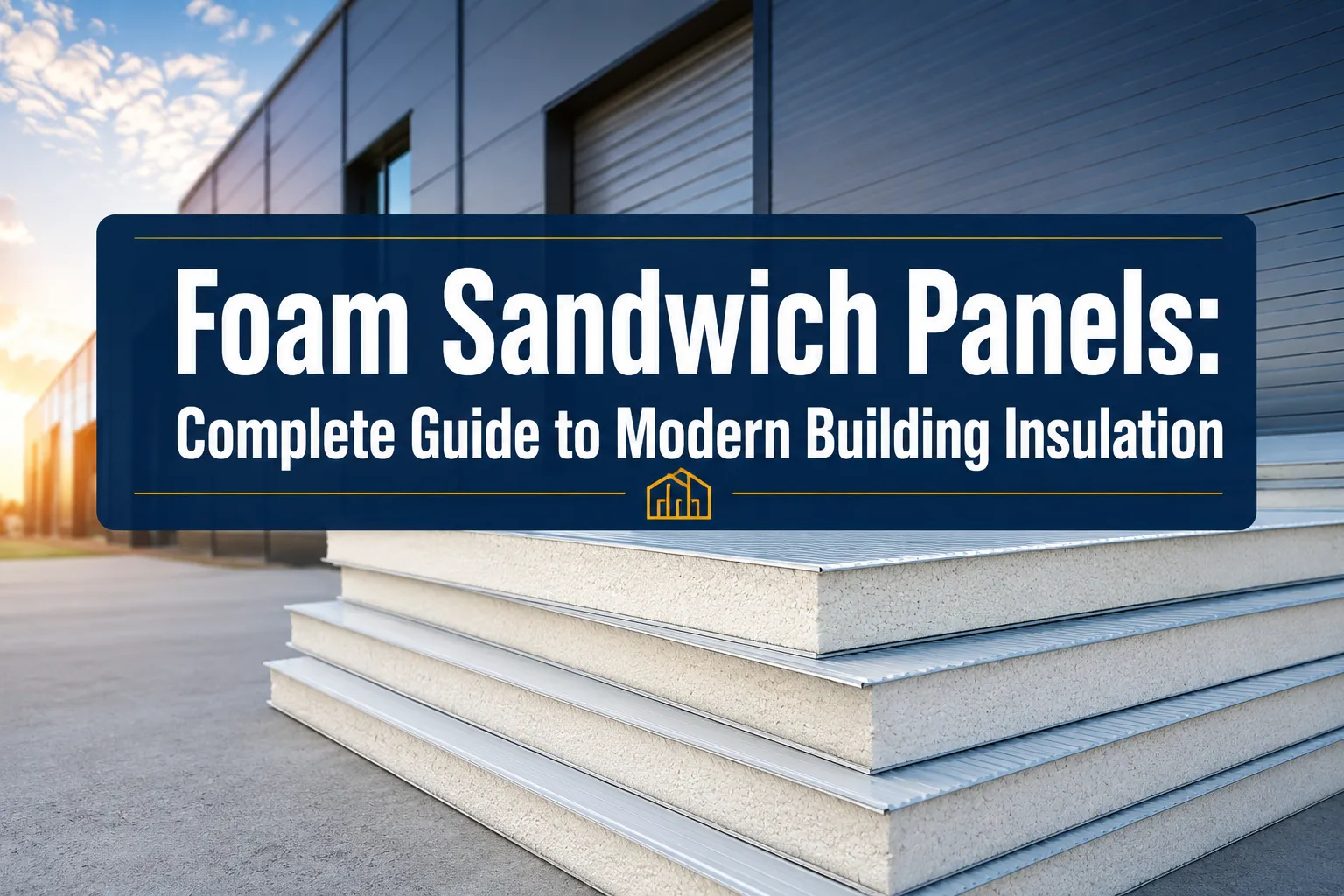
Foam sandwich panels are composite building materials consisting of a foam insulation core (typically polyurethane, polystyrene, or polyisocyanurate) bonded between two metal facings, usually steel or aluminum. These panels provide structural strength, thermal insulation, and weather protection in a single integrated system, making them ideal for commercial buildings, warehouses, and industrial facilities where energy efficiency and quick installation are priorities.
Key Takeaways
- Foam sandwich panels combine insulation and structure in one product, reducing construction time by 30-50% compared to traditional methods
- Available core materials include EPS, PU, PIR, and rockwool, each offering different R-values and fire ratings
- Typical R-values range from R-7 to R-30 depending on thickness and foam type
- Installation costs range from $8-25 per square foot including materials and labor
- Best applications include warehouse walls, factory roofing, cold storage facilities, and commercial building exteriors
- Fire resistance varies significantly by core material, with rockwool offering the highest fire ratings
- Proper vapor barrier installation prevents 90% of moisture-related problems
- Expected lifespan is 25-40 years with proper installation and maintenance
What Are Foam Sandwich Panels and How Do They Work
Foam sandwich panels are engineered building components that sandwich a lightweight foam core between two rigid metal sheets to create a single structural and insulating element. The foam core provides thermal resistance while the metal facings handle structural loads and weather protection.
The panels work through a composite action where the metal skins carry tensile and compressive forces while the foam core resists shear forces and prevents the metal faces from buckling. This creates a structural beam that's much stronger than the sum of its individual components.
Common core materials include:
- Expanded Polystyrene (EPS): Lowest cost, R-4 per inch, good for basic applications
- Polyurethane (PU): Higher R-value at R-6.5 per inch, better adhesion to metal facings
- Polyisocyanurate (PIR): Highest thermal performance at R-7+ per inch, excellent fire resistance
- Rockwool: Superior fire rating, acoustic properties, but lower R-value at R-4 per inch
The metal facings are typically 24-26 gauge steel or aluminum with protective coatings like galvanized, Galvalume, or painted finishes. Panel thicknesses range from 2 inches to 8 inches depending on insulation requirements and structural loads.
For detailed guidance on selecting appropriate thickness for your project, see our complete guide to choosing sandwich panel thickness.
Foam Sandwich Panels vs Fiberglass Insulation: Which Is Better
Foam sandwich panels outperform fiberglass insulation in most commercial applications due to superior thermal performance, faster installation, and integrated weather protection, though fiberglass costs 40-60% less upfront.
Thermal Performance Comparison:
- Foam panels: R-20 to R-30 in 3-4 inch thickness
- Fiberglass batts: R-13 to R-19 in same thickness
- Foam panels have no thermal bridging through studs
- Fiberglass loses 15-25% efficiency due to metal framing thermal bridges
Installation Speed:
- Foam panels: Complete wall system in single installation
- Fiberglass: Requires separate framing, sheathing, vapor barrier, and siding
- Labor time reduction: 50-70% with foam panels
Moisture Performance:
- Foam cores don't absorb water and maintain R-value when wet
- Fiberglass loses 50% of insulating value when moisture content exceeds 1%
- Foam panels include integrated vapor barrier
Choose foam sandwich panels if: You need fast installation, maximum energy efficiency, or building in humid climates. Best for warehouses, factories, and commercial buildings.
Choose fiberglass if: Budget is primary concern, building residential structures, or local codes require specific framing methods.
How Much Do Foam Sandwich Panels Cost
Foam sandwich panel costs range from $8-25 per square foot installed, with material costs of $4-12 per square foot and installation adding $4-13 per square foot depending on panel type, thickness, and project complexity.
Cost Breakdown by Core Type:
- EPS panels: $8-14 per sq ft installed
- PU panels: $12-18 per sq ft installed
- PIR panels: $15-22 per sq ft installed
- Rockwool panels: $18-25 per sq ft installed
Factors Affecting Price:
- Panel thickness (thicker = higher cost)
- Metal facing gauge and coating type
- Project size (larger projects get better pricing)
- Installation complexity and building height
- Geographic location and local labor rates
Additional Costs to Consider:
- Structural engineering: $2,000-8,000 per project
- Building permits: $500-3,000
- Crane rental for installation: $800-2,500 per day
- Trim and flashing materials: $2-4 per linear foot
For current pricing in Bangladesh, check our detailed sandwich panel price guide.
The higher upfront cost typically pays back in 3-7 years through energy savings and reduced construction time.
Where to Buy Foam Sandwich Panels
Purchase foam sandwich panels from specialized building envelope suppliers, metal building manufacturers, or directly from panel fabricators for the best selection and technical support. Avoid general lumber yards which typically carry limited options.
Best Sources for Purchase:
Specialized Panel Suppliers:
- Offer widest selection of core types and thicknesses
- Provide technical support and engineering assistance
- Can custom fabricate panels to project specifications
- Typically offer better pricing on large orders
Metal Building Manufacturers:
- Include panels as part of complete building systems
- Handle engineering and installation coordination
- Good option for turnkey projects
- May have limited core material options
Direct from Fabricators:
- Best pricing for large commercial projects
- Custom panel configurations available
- Shorter lead times for standard products
- Require minimum order quantities
What to Verify Before Purchasing:
- Panel meets local building codes and fire ratings
- Manufacturer provides structural load tables
- Warranty terms (typically 10-20 years on materials)
- Installation support and approved contractor network
For Bangladesh-specific suppliers, see our comprehensive guide to sandwich panel manufacturers in Dhaka.
Avoid purchasing from: General contractors without panel expertise, online retailers without technical support, or suppliers who cannot provide load tables and installation guidelines.
Foam Sandwich Panel Installation Problems and Solutions
The most common foam sandwich panel installation problems are improper fastening, inadequate sealing, and thermal bridging, which can be prevented with proper planning and experienced installers.
Major Installation Issues:
1. Fastener Problems:
- Problem: Over-driving screws compresses foam, under-driving allows water infiltration
- Solution: Use torque-controlled drivers set to manufacturer specifications
- Prevention: Train installers on proper fastening techniques, use color-changing washers
2. Panel Alignment Issues:
- Problem: Panels not plumb or level create gaps and stress concentrations
- Solution: Use laser levels and temporary bracing during installation
- Prevention: Verify building frame is square and level before panel installation
3. Sealant Failures:
- Problem: Inadequate sealant application allows air and water infiltration
- Solution: Use structural glazing sealants rated for building movement
- Prevention: Follow manufacturer's sealant specifications, tool joints properly
4. Thermal Bridging:
- Problem: Metal fasteners and structural connections create heat loss paths
- Solution: Use thermal break washers and minimize penetrations
- Prevention: Design thermal breaks into structural connections
5. Moisture Infiltration:
- Problem: Water enters through panel joints or penetrations
- Solution: Install proper flashing and vapor barriers at all joints
- Prevention: Follow manufacturer's weatherproofing details exactly
For professional installation services, consider our sandwich panel installation service in Bangladesh.
Critical Success Factor: Use installers certified by the panel manufacturer and follow their installation manual exactly.
Best Foam Sandwich Panels for Roofing
PIR (polyisocyanurate) foam sandwich panels are the best choice for roofing applications due to their superior thermal performance, fire resistance, and dimensional stability under temperature cycling.
Top Roofing Panel Options:
PIR Core Panels (Best Overall):
- R-value: R-7 to R-8 per inch thickness
- Fire rating: Class A when properly specified
- Temperature stability: Maintains properties from -100°F to 200°F
- Ideal thickness: 4-6 inches for most climates
PU Core Panels (Good Alternative):
- R-value: R-6.5 per inch thickness
- Lower cost than PIR panels
- Good adhesion between core and facings
- Recommended thickness: 4-8 inches
Key Roofing Specifications:
- Minimum 24-gauge steel facings for structural requirements
- Galvalume or painted finish for corrosion resistance
- Standing seam or through-fastened attachment systems
- Vapor barrier on warm side of assembly
Avoid for Roofing:
- EPS core panels (poor fire rating, dimensional instability)
- Panels thinner than 3 inches (insufficient R-value)
- Aluminum facings in high-wind zones (insufficient strength)
For thickness selection guidance, see our guide on roof panel thickness.
Climate Considerations:
- Hot climates: Use light-colored facings to reduce heat gain
- Cold climates: Increase thickness to 6-8 inches for adequate R-value
- High-wind areas: Specify higher gauge facings and increased fastening
Foam Sandwich Panels for Walls vs Floors
Wall and floor applications require different foam sandwich panel specifications due to varying load requirements, moisture exposure, and installation methods.
Wall Panel Requirements:
- Structural loads: Wind and seismic forces, minimal compression
- Recommended cores: PU, PIR, or rockwool for fire resistance
- Typical thickness: 3-6 inches depending on climate zone
- Facing options: 24-26 gauge steel, architectural finishes available
- Installation: Vertical orientation, mechanical fastening to structure
Floor Panel Requirements:
- Structural loads: Heavy compression and point loads
- Recommended cores: High-density PU or PIR (minimum 3 lb/ft³ density)
- Typical thickness: 4-8 inches for structural spanning capability
- Facing requirements: Minimum 22-gauge steel, often requires structural decking
- Installation: Horizontal spanning between supports
Key Differences:
| Application | Core Density | Facing Gauge | Primary Loads | Moisture Concerns |
|---|---|---|---|---|
| Walls | 1.5-3 lb/ft³ | 24-26 gauge | Wind/seismic | Exterior weather |
| Floors | 3-6 lb/ft³ | 20-22 gauge | Compression | Vapor from below |
Floor Installation Considerations:
- Requires structural engineering for load calculations
- May need additional structural decking over panels
- Vapor barrier critical to prevent moisture drive from below
- Access flooring systems often preferred over direct panel installation
Wall Installation Considerations:
- Focus on air sealing and weather resistance
- Architectural finishes available for exterior applications
- Fire-rated assemblies required for certain occupancies
For specific wall applications, see our wall cladding guide.
Are Foam Sandwich Panels Fire Resistant
Fire resistance of foam sandwich panels varies significantly by core material, with rockwool cores offering the highest fire ratings and EPS cores providing the least fire protection.
Fire Performance by Core Type:
Rockwool Core Panels:
- Fire rating: Up to 4-hour fire resistance when properly detailed
- Non-combustible core material (melting point >2000°F)
- Passes ASTM E119 fire tests for structural assemblies
- Best choice for hospitals, schools, and high-occupancy buildings
PIR Core Panels:
- Fire rating: 1-2 hour fire resistance possible
- Self-extinguishing foam with flame-retardant additives
- Class A surface burning characteristics when tested per ASTM E84
- Good choice for commercial and industrial buildings
PU Core Panels:
- Fire rating: 30-60 minutes typical
- Requires fire-retardant additives for building code compliance
- May produce toxic smoke when burning
- Acceptable for warehouses and agricultural buildings
EPS Core Panels:
- Fire rating: Limited, typically 30 minutes maximum
- Combustible material that melts and drips when heated
- Not suitable for occupied buildings without additional fire protection
- Use limited to agricultural and storage applications
For fire-rated options in Bangladesh, see our fire rated sandwich panel guide.
Building Code Requirements:
- Occupancy type determines minimum fire rating required
- Some applications require non-combustible core materials
- Fire barriers and smoke barriers have specific requirements
- Local fire marshal approval may be required
Critical Factor: Always verify that the complete panel assembly (not just the core) meets required fire ratings for your specific application.
Foam Sandwich Panel Moisture and Condensation Issues
Moisture problems in foam sandwich panels typically result from inadequate vapor barrier installation or thermal bridging, but proper design prevents 90% of condensation issues.
Primary Moisture Concerns:
Interstitial Condensation:
- Cause: Warm, humid air reaches cold surfaces within the wall assembly
- Solution: Install continuous vapor barrier on warm side of insulation
- Prevention: Calculate dew point location and ensure vapor barrier placement prevents condensation
Thermal Bridging Condensation:
- Cause: Metal fasteners and structural connections create cold spots
- Solution: Use thermal break washers and minimize penetrations
- Prevention: Design thermal breaks into all structural connections
Edge Sealing Failures:
- Cause: Gaps at panel joints allow humid air infiltration
- Solution: Seal all joints with appropriate sealants and gaskets
- Prevention: Follow manufacturer's sealing details exactly
Moisture Management Strategies:
Vapor Barrier Placement:
- Cold climates: Vapor barrier on interior (warm) side
- Hot, humid climates: Vapor barrier on exterior side or use vapor-permeable design
- Mixed climates: Use "smart" vapor retarders that adjust permeability
Ventilation Design:
- Provide adequate ventilation to control interior humidity
- Consider energy recovery ventilation to maintain efficiency
- Avoid creating vapor traps in wall assemblies
Material Selection:
- Choose foam cores with low water absorption (PU and PIR preferred)
- Specify facings with appropriate vapor permeability
- Use compatible sealants that maintain flexibility
Common Mistakes to Avoid:
- Installing vapor barrier on wrong side of assembly
- Using incompatible materials that create vapor traps
- Inadequate sealing of penetrations and joints
- Ignoring thermal bridging at structural connections
Who Should Use Foam Sandwich Panels
Foam sandwich panels are best suited for commercial, industrial, and agricultural buildings where energy efficiency, construction speed, and long-term durability are priorities over initial cost savings.
Ideal Applications:
Commercial Buildings:
- Office buildings requiring energy efficiency
- Retail stores with large wall and roof areas
- Restaurants and food service facilities needing easy cleaning
- Buildings pursuing LEED or energy code compliance
Industrial Facilities:
- Manufacturing plants with climate control requirements
- Warehouses and distribution centers
- Cold storage and refrigerated facilities
- Clean rooms and controlled environments
Agricultural Buildings:
- Poultry farms requiring biosecurity and climate control
- Dairy facilities needing washable surfaces
- Grain storage buildings
- Livestock housing with ventilation requirements
For poultry applications specifically, see our poultry farm sandwich panel guide.
Building Characteristics That Favor Foam Panels:
- Large, unobstructed wall and roof areas
- Need for rapid construction schedules
- Energy efficiency requirements
- Minimal architectural detailing required
- Single-story or low-rise construction
Not Recommended For:
- Residential construction (cost and code issues)
- Buildings requiring complex architectural details
- High-rise construction over 3-4 stories
- Projects where initial cost is the only consideration
- Areas with extreme seismic activity without proper engineering
Decision Factors:
- Choose foam panels if: Energy costs are significant, construction schedule is tight, or building will have controlled environment needs
- Consider alternatives if: Budget is extremely limited, building codes restrict use, or architectural complexity is high
Common Mistakes When Installing Foam Sandwich Panels
The three most critical installation mistakes are improper fastening, inadequate air sealing, and ignoring thermal bridging, which can reduce energy performance by 30-50% and cause long-term durability problems.
Critical Installation Errors:
1. Fastener Mistakes:
- Over-torquing screws: Compresses foam core, reduces insulation value
- Under-torquing screws: Allows water infiltration and panel movement
- Wrong fastener type: Using standard screws instead of self-sealing fasteners
- Incorrect spacing: Too few fasteners cause panel failure, too many create thermal bridges
2. Air Sealing Failures:
- Inadequate sealant application: Leaving gaps at panel joints
- Wrong sealant type: Using non-structural sealants for structural applications
- Poor surface preparation: Applying sealant to dirty or wet surfaces
- Ignoring expansion joints: Not accommodating building movement
3. Thermal Bridge Problems:
- Continuous metal connections: Allowing unbroken thermal paths through insulation
- Missing thermal breaks: Not using thermal break washers at fasteners
- Structural penetrations: Inadequate insulation around structural members
- Window and door details: Poor integration with panel system
4. Sequencing Errors:
- Installing panels before structure is ready: Panels damaged during other construction
- Wrong installation order: Installing panels that prevent access for other trades
- Weather exposure: Installing panels in inappropriate weather conditions
5. Quality Control Lapses:
- No installation inspection: Missing defects during installation when easy to fix
- Inadequate documentation: Not recording panel locations and fastener patterns
- Skipping manufacturer requirements: Deviating from installation manual
Prevention Strategies:
- Use only manufacturer-certified installers
- Conduct daily installation inspections
- Follow installation manual exactly
- Maintain proper job site conditions
- Document installation with photos
For professional installation, consider our installation service options.
Foam Sandwich Panel R-Value and Thermal Performance
Foam sandwich panel R-values range from R-14 to R-56 depending on thickness and core material, with PIR cores providing the highest thermal performance at R-7+ per inch of thickness.
R-Value by Core Material:
| Core Type | R-Value per Inch | 4" Panel R-Value | 6" Panel R-Value |
|---|---|---|---|
| EPS | R-4.0 | R-16 | R-24 |
| PU | R-6.5 | R-26 | R-39 |
| PIR | R-7.2 | R-29 | R-43 |
| Rockwool | R-4.3 | R-17 | R-26 |
Thermal Performance Advantages:
- No thermal bridging: Continuous insulation eliminates framing thermal bridges
- Air barrier integration: Sealed panel joints reduce air infiltration
- Consistent performance: Factory-controlled manufacturing ensures uniform R-values
- Aging stability: Quality foam cores maintain R-value over time
Real-World Performance Factors:
Installation Quality Impact:
- Proper installation: Achieves 95-100% of rated R-value
- Poor installation: May reduce performance by 20-40%
- Air leakage: Each 1% air leakage reduces effective R-value by 5-10%
Temperature Effects:
- PIR and PU cores maintain performance across wide temperature ranges
- EPS performance decreases slightly at very low temperatures
- Rockwool performance remains constant regardless of temperature
Moisture Impact:
- Foam cores maintain R-value when exposed to moisture
- Water absorption less than 2% by volume for quality panels
- Proper vapor barrier prevents moisture-related performance loss
For detailed thermal performance analysis, see our thermal performance guide.
Energy Code Compliance:
Most energy codes require R-20 to R-30 for commercial walls and R-30 to R-49 for roofs, easily achievable with 4-6 inch foam sandwich panels.
How Long Do Foam Sandwich Panels Last
Quality foam sandwich panels last 25-40 years with proper installation and maintenance, with the metal facings typically determining overall lifespan rather than the foam core.
Lifespan by Component:
Metal Facings:
- Galvanized steel: 25-30 years in normal environments
- Galvalume steel: 30-40 years with superior corrosion resistance
- Painted finishes: 20-30 years depending on coating quality
- Aluminum: 40+ years but higher initial cost
Foam Cores:
- PIR and PU: 40+ years with minimal degradation
- EPS: 30+ years but may compress slightly over time
- Rockwool: 50+ years, essentially permanent material
Factors Affecting Lifespan:
Environmental Conditions:
- Coastal areas: Salt air reduces metal facing life by 20-30%
- Industrial environments: Chemical exposure may accelerate degradation
- UV exposure: Painted finishes fade but don't affect structural performance
- Freeze-thaw cycles: Minimal impact on properly installed panels
Installation Quality:
- Professional installation: Full expected lifespan
- Poor installation: May reduce lifespan by 30-50%
- Proper fastening: Critical for long-term performance
- Adequate sealing: Prevents water infiltration damage
Maintenance Requirements:
- Annual inspection of sealants and fasteners
- Resealing joints every 10-15 years
- Touch-up painting as needed for appearance
- Gutter and drainage maintenance to prevent water issues
Warning Signs of Deterioration:
- Rust stains or corrosion on metal facings
- Gaps or failures in sealant joints
- Loose or missing fasteners
- Water stains indicating infiltration
Warranty Coverage:
- Material warranties: Typically 10-20 years
- Installation warranties: Usually 1-5 years
- Performance warranties: May cover thermal performance for 10+ years
For warranty information in Bangladesh, see our sandwich panel warranty guide.
Foam Sandwich Panel Environmental Impact
Foam sandwich panels have a moderate environmental impact with energy savings during use typically offsetting manufacturing emissions within 2-5 years of installation in energy-efficient buildings.
Environmental Considerations:
Manufacturing Impact:
- Foam production requires petrochemical feedstocks
- Energy-intensive manufacturing process
- Some foam types use blowing agents with global warming potential
- Steel and aluminum facings require significant energy to produce
Positive Environmental Aspects:
- Energy Savings: Superior insulation reduces building energy consumption by 20-40%
- Construction Efficiency: Faster installation reduces construction site impacts
- Durability: Long lifespan reduces replacement frequency
- Recyclability: Metal facings are fully recyclable at end of life
Sustainability Improvements:
- Newer foam formulations use low-GWP blowing agents
- Recycled content available in metal facings
- Some manufacturers offer take-back programs for panel recycling
- Energy recovery possible from foam cores at end of life
Green Building Certification:
- Contributes to LEED points for energy performance
- Helps meet energy code requirements
- Supports net-zero energy building goals
- Qualifies for energy efficiency incentive programs
For green building applications, see our green building certification guide.
Life Cycle Assessment:
- Manufacturing: High initial carbon footprint
- Use phase: Significant energy savings over 25-40 year lifespan
- End of life: Metal components recyclable, foam disposal varies by type
- Net impact: Typically carbon negative over full building lifecycle
Sustainable Alternatives:
- Bio-based foam cores (limited availability)
- Recycled content metal facings
- Natural fiber insulation cores (rockwool, cork)
- Design for disassembly to improve recyclability
Frequently Asked Questions
What is the difference between EPS and PU foam sandwich panels?
EPS panels cost 20-30% less but provide lower R-values (R-4 vs R-6.5 per inch) and have limited fire resistance compared to PU panels. PU panels offer better adhesion to metal facings and superior thermal performance, making them better for commercial applications despite higher cost.
Can foam sandwich panels be used for residential construction?
Foam sandwich panels can be used for residential construction but are typically cost-prohibitive and may not meet residential building codes in many areas. They're most cost-effective for large commercial, industrial, or agricultural buildings rather than homes.
How thick should foam sandwich panels be for a warehouse?
Warehouse foam sandwich panels should be 4-6 inches thick for walls and 4-8 inches thick for roofs, depending on climate zone and energy requirements. Colder climates require thicker panels to meet energy codes, while warmer climates can use thinner panels.
Do foam sandwich panels require a structural frame?
Foam sandwich panels require structural support for major loads but can span significant distances between supports. They cannot replace the primary structural frame but reduce the amount of secondary framing needed compared to traditional construction methods.
What maintenance do foam sandwich panels require?
Foam sandwich panels require annual inspection of sealants and fasteners, resealing of joints every 10-15 years, and touch-up painting as needed. Proper gutter maintenance prevents water infiltration, which is the primary cause of panel problems.
Are foam sandwich panels waterproof?
Foam sandwich panels are water-resistant but not waterproof. They require proper installation of sealants, flashing, and vapor barriers to prevent water infiltration. The panels themselves shed water, but joints and penetrations must be properly sealed.
Can foam sandwich panels be painted or finished?
Foam sandwich panels come with factory-applied finishes that typically last 20-30 years. They can be repainted using compatible paint systems, but field-applied finishes generally don't last as long as factory finishes.
What building codes apply to foam sandwich panels?
Foam sandwich panels must meet local building codes for structural loads, fire resistance, and energy performance. Most codes reference standards like ASTM E119 for fire testing and ASCE 7 for structural design. Always verify code compliance before specifying panels.
How are foam sandwich panels attached to the building structure?
Foam sandwich panels attach to the building structure using self-drilling screws with sealing washers, typically spaced 12-24 inches on center. The panels may attach to steel purlins, wood framing, or concrete using appropriate fasteners for each substrate.
Do foam sandwich panels provide sound insulation?
Foam sandwich panels provide moderate sound insulation, with rockwool cores offering the best acoustic performance. They're effective for reducing exterior noise but may require additional acoustic treatment for critical sound control applications.
Can foam sandwich panels be cut or modified on site?
Foam sandwich panels can be cut on site using appropriate tools, but field cuts require sealing to prevent moisture infiltration and may affect structural performance. Factory fabrication to exact dimensions is preferred when possible.
What happens to foam sandwich panels in a fire?
Fire behavior depends on core material. Rockwool cores are non-combustible, PIR cores are self-extinguishing, while EPS cores are combustible and may contribute to fire spread. Always specify panels with appropriate fire ratings for the intended use.
SEO Meta Title: Foam Sandwich Panels: Complete 2026 Guide to Costs & Installation