Last updated: July 31, 2026

Quick Answer
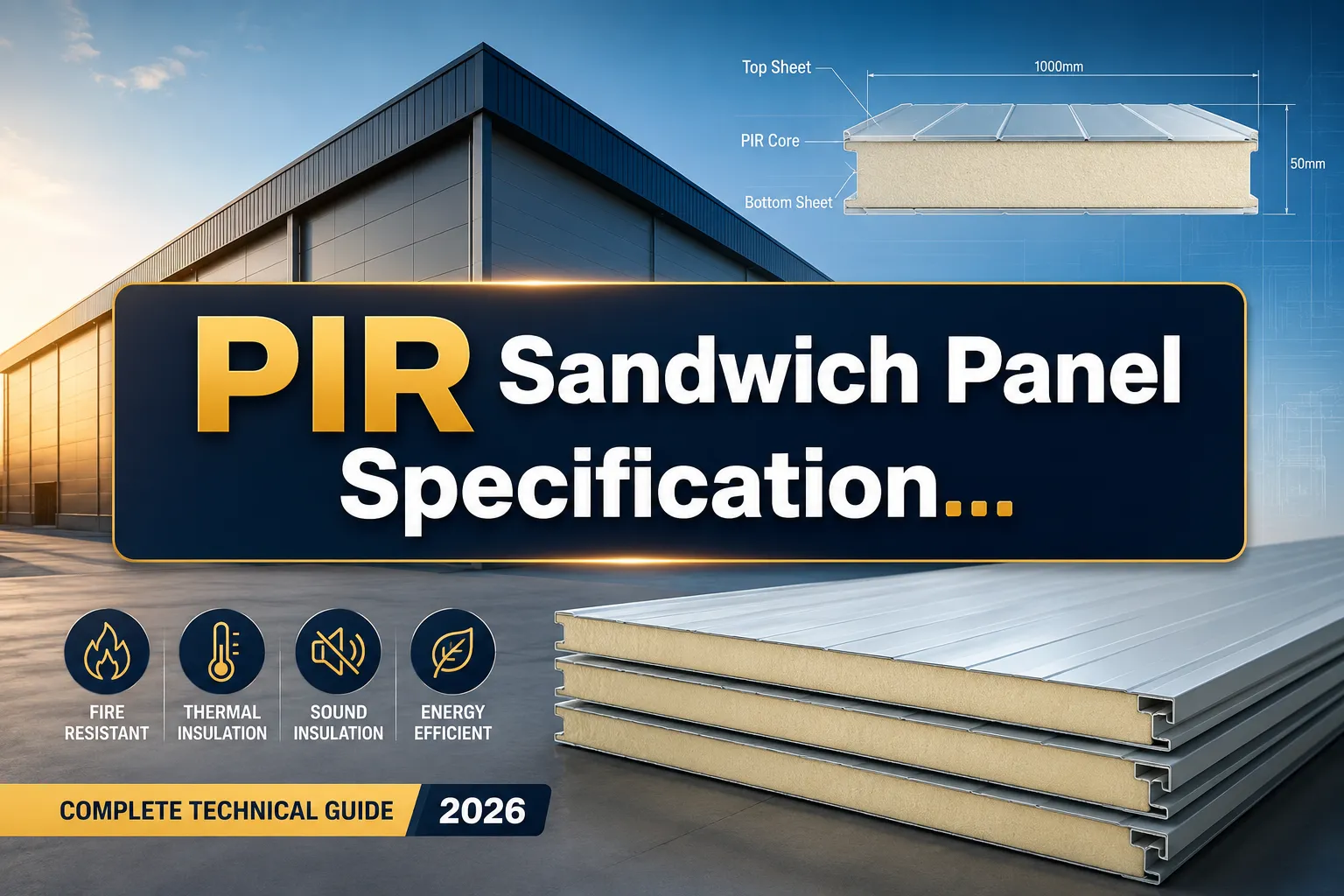
PIR sandwich panel specification defines the technical requirements for polyisocyanurate foam core panels including thickness (50-200mm), thermal conductivity (0.022-0.028 W/mK), fire ratings (Class A or B), and facing materials (steel, aluminum). Standard specifications cover core density (40-45 kg/m³), compressive strength (≥150 kPa), and dimensional tolerances for construction applications.
Key Takeaways
- PIR sandwich panels offer thermal conductivity values between 0.022-0.028 W/mK, superior to most alternatives
- Standard thicknesses range from 50mm to 200mm with custom options available up to 300mm
- Fire ratings typically achieve Class A or Class B certification under ASTM E84 standards
- Core density specifications range from 40-45 kg/m³ for optimal strength-to-weight ratio
- Facing materials include pre-painted steel, stainless steel, and aluminum in various gauges
- Compressive strength requirements exceed 150 kPa for structural applications
- Moisture absorption rates stay below 2% by volume for long-term durability
- Temperature resistance spans from -40°C to +120°C for most applications
- Standard panel widths measure 1000mm with lengths up to 12 meters
- Installation requires specific fastener spacing and sealing protocols per manufacturer specifications
What Is a PIR Sandwich Panel and How Does It Work
PIR sandwich panels consist of a rigid polyisocyanurate foam core laminated between two metal facings, creating a composite building element that provides structural strength, thermal insulation, and weather protection in one system. The polyisocyanurate foam core contains closed-cell structure that traps air, delivering exceptional thermal performance while maintaining structural integrity.
The panels work through three key mechanisms: thermal bridging prevention, structural load distribution, and moisture barrier protection. The continuous foam core eliminates thermal bridges that occur with traditional framing methods, while the metal facings distribute loads across the panel width. The factory-applied adhesive bonds create a monolithic structure that performs better than field-assembled alternatives.
Core specifications typically include:
- Density: 40-45 kg/m³
- Closed cell content: >90%
- Thermal conductivity: 0.022-0.028 W/mK
- Compressive strength: 150-200 kPa
- Shear strength: 100-150 kPa
Choose PIR panels when thermal performance takes priority over cost, particularly in climate-controlled environments like cold storage facilities or clean rooms. Avoid PIR panels in applications exceeding 120°C continuous exposure, where phenolic or mineral wool cores perform better.
PIR Sandwich Panel vs Polyurethane Foam: Which Is Better
PIR sandwich panels outperform polyurethane (PU) foam panels in fire resistance and high-temperature applications, while PU panels offer better adhesion properties and lower cost for standard building applications. PIR foam maintains its insulating properties at temperatures up to 120°C compared to PU's 80°C limit.
Fire performance differences represent the most significant distinction. PIR foam achieves Class A fire ratings more easily due to its chemical structure, which forms a protective char layer when exposed to flame. PU foam typically requires additional fire retardants to meet building codes, adding cost and potentially reducing thermal performance.
Thermal conductivity comparison:
- PIR: 0.022-0.028 W/mK
- PU: 0.024-0.030 W/mK
- Performance advantage: PIR delivers 5-10% better insulation
Cost considerations favor PU panels for budget-conscious projects, with typical price differences of 10-15% in favor of PU. However, PIR panels often justify the premium through reduced thickness requirements and longer service life in demanding applications.
Choose PIR panels for fire-rated applications, high-temperature environments, or projects requiring maximum thermal efficiency. Select PU panels for standard warehouse construction, agricultural buildings, or applications where initial cost drives decisions.
PIR Sandwich Panel Thickness and R-Value Specifications
PIR sandwich panel thickness directly determines thermal resistance (R-value), with standard options ranging from 50mm (R-7.1) to 200mm (R-28.4) based on foam thermal conductivity of 0.025 W/mK. Thickness selection depends on climate zone requirements, building codes, and energy efficiency targets.
Standard thickness options and R-values:
- 50mm: R-7.1 (suitable for mild climates)
- 75mm: R-10.6 (standard commercial applications)
- 100mm: R-14.2 (cold storage, freezer applications)
- 150mm: R-21.3 (extreme climate zones)
- 200mm: R-28.4 (specialized cold storage)
Thickness selection criteria include local building code minimums, HVAC load calculations, and cost-benefit analysis. Increasing thickness beyond optimal points delivers diminishing returns, as doubling thickness doesn't double energy savings due to other building envelope factors.
For warehouse applications, 75-100mm thickness typically provides the best balance of thermal performance and cost. Cold room applications require 100-150mm minimum thickness depending on target temperature ranges.
Common thickness selection mistakes include oversizing for mild climates (wasting money) or undersizing for cold storage (causing condensation issues). Always verify thickness requirements with thermal modeling software or qualified engineers for critical applications.
How Much Does a PIR Sandwich Panel Cost Per Square Meter
PIR sandwich panel costs range from $25-45 per square meter for standard thicknesses (75-100mm) in 2026, with pricing varying based on thickness, facing materials, order quantity, and regional market conditions. Thicker panels and premium facings increase costs significantly.
Cost breakdown by thickness (approximate 2026 pricing):
- 50mm: $22-28 per m²
- 75mm: $28-35 per m²
- 100mm: $35-42 per m²
- 150mm: $48-58 per m²
- 200mm: $62-75 per m²
Factors affecting pricing include facing material selection (standard pre-painted steel vs. stainless steel), panel width and length, edge details, and factory location relative to project site. Custom colors, special coatings, and non-standard dimensions typically add 10-20% to base pricing.
Volume discounts apply for orders exceeding 1000 m², with potential savings of 15-25% compared to small quantity pricing. Transportation costs can add $2-5 per m² depending on distance and accessibility.
For current sandwich panel pricing in Bangladesh, regional suppliers offer competitive rates with local manufacturing advantages. Budget an additional 20-30% for installation, fasteners, and accessories when calculating total project costs.
PIR Sandwich Panel Fire Rating and Safety Standards
PIR sandwich panels achieve Class A or Class B fire ratings under ASTM E84 testing, with flame spread indices typically below 25 and smoke development indices under 450. The polyisocyanurate foam's inherent fire resistance comes from its chemical structure, which forms protective char layers when exposed to heat.
Key fire safety standards include:
- ASTM E84: Surface burning characteristics
- ASTM E119: Fire resistance of building assemblies
- FM 4880: Fire performance of insulated wall and roof panels
- UL 263: Fire tests of building construction materials
Fire rating performance depends on panel thickness, facing materials, and installation details. Thicker panels generally achieve better fire ratings due to increased thermal mass and insulation. Steel facings provide better fire performance than aluminum facings in most test scenarios.
Installation requirements for fire-rated assemblies include proper joint sealing, approved fasteners, and compliance with manufacturer specifications. Improper installation can void fire ratings regardless of panel performance. Common failures occur at panel joints, penetrations, and connections to structural elements.
For projects requiring fire-rated sandwich panels, specify panels with third-party fire test certifications matching local building code requirements. Verify that installation contractors understand fire-rated assembly requirements to maintain code compliance.
Where Should You Use PIR Sandwich Panels in Construction
PIR sandwich panels work best in climate-controlled buildings requiring superior thermal performance, including cold storage facilities, clean rooms, food processing plants, and pharmaceutical manufacturing. Their high R-value per inch and fire resistance make them ideal for applications where space and safety are priorities.
Optimal applications include:
- Cold storage and freezer facilities (-20°C to +5°C)
- Clean room construction (pharmaceutical, electronics)
- Food processing and packaging facilities
- Commercial kitchens and restaurants
- Hospital and laboratory construction
- Data center construction
Building envelope locations where PIR panels excel include exterior walls, roof assemblies, and interior partition walls requiring thermal separation. They perform particularly well in buildings with significant temperature differentials between interior and exterior environments.
Avoid PIR panels in applications exceeding 120°C continuous exposure, high-humidity environments without proper vapor barriers, or budget-constrained projects where PU or EPS alternatives provide adequate performance. They're also unsuitable for below-grade applications due to moisture sensitivity.
For insulated sandwich panel applications, PIR panels justify their premium cost through energy savings, reduced HVAC equipment sizing, and improved occupant comfort in demanding environments.
PIR Sandwich Panel Installation Problems and Solutions
Common PIR sandwich panel installation problems include thermal bridging at fasteners, air leakage at joints, moisture infiltration, and structural inadequacy due to improper support spacing. Most issues stem from inadequate planning, incorrect fastener selection, or failure to follow manufacturer specifications.
Thermal bridging solutions require thermal break fasteners or continuous insulation strips at panel connections. Standard steel fasteners create thermal bridges that can reduce overall wall R-value by 15-25%. Use fasteners with thermal breaks or increase insulation thickness to compensate.
Air sealing challenges occur at panel joints, penetrations, and building transitions. Solutions include:
- Continuous sealant beads at all horizontal and vertical joints
- Proper overlap sequencing during installation
- Sealed penetration details for utilities and equipment
- Transition flashing at roof-to-wall connections
Moisture problems typically result from inadequate vapor barrier installation or condensation at thermal bridges. Install continuous vapor barriers on the warm side of assemblies and ensure proper ventilation in cavity spaces.
Structural support issues arise when panel spans exceed manufacturer recommendations or support spacing is inadequate. Verify structural calculations before installation and provide intermediate supports for long spans or high wind load areas.
Professional sandwich panel installation services can prevent these common problems through proper planning, quality materials, and experienced installation crews.
Best Alternatives to PIR Sandwich Panels for Insulation
Rockwool sandwich panels provide superior fire performance and moisture resistance compared to PIR panels, making them ideal for high-risk applications like petrochemical facilities and high-rise construction. Polyurethane (PU) panels offer similar thermal performance at lower cost for standard commercial buildings.
Alternative core materials include:
- Rockwool: Fire-resistant, moisture-tolerant, higher cost
- Polyurethane (PU): Similar thermal performance, lower cost, temperature limitations
- EPS (Expanded Polystyrene): Lowest cost, adequate performance for mild climates
- Phenolic: Highest fire resistance, premium cost, specialized applications
Performance comparison for thermal conductivity:
- PIR: 0.022-0.028 W/mK
- PU: 0.024-0.030 W/mK
- Rockwool: 0.037-0.042 W/mK
- EPS: 0.032-0.038 W/mK
- Phenolic: 0.018-0.025 W/mK
Rockwool sandwich panels excel in fire-critical applications but require greater thickness to achieve equivalent R-values. EPS sandwich panels provide cost-effective solutions for warehouse and agricultural applications.
Choose alternatives based on project priorities: rockwool for fire safety, PU for cost efficiency, EPS for basic applications, or phenolic for extreme fire resistance requirements.
PIR Sandwich Panel Moisture Resistance and Durability
PIR sandwich panels demonstrate excellent moisture resistance with water absorption rates below 2% by volume, but require proper vapor barrier installation and edge sealing to prevent moisture infiltration into the foam core. The closed-cell foam structure resists moisture absorption better than open-cell alternatives.
Moisture resistance specifications:
- Water absorption: <2% by volume (ASTM D2842)
- Water vapor permeability: 2-4 perms (depending on facings)
- Freeze-thaw resistance: 300+ cycles without degradation
- Humidity resistance: Stable performance up to 95% RH
Durability factors include UV exposure protection (provided by metal facings), thermal cycling resistance, and chemical compatibility. PIR foam maintains structural properties through temperature cycles from -40°C to +120°C without significant degradation.
Service life expectations range from 25-40 years depending on environmental conditions, installation quality, and maintenance practices. Proper installation with continuous vapor barriers and sealed joints extends service life significantly.
Failure modes typically involve moisture infiltration through damaged facings, failed sealants, or thermal bridging condensation. Regular inspection and maintenance of sealants, fasteners, and drainage systems prevent most durability issues.
For applications requiring maximum moisture resistance, consider thermal insulation sandwich panels with enhanced vapor barrier systems and sealed joint designs.
Who Needs PIR Sandwich Panels: Residential vs Commercial
Commercial and industrial applications drive PIR sandwich panel demand due to their superior thermal performance, fire resistance, and structural capabilities that justify premium costs over residential alternatives. Residential applications typically use less expensive insulation methods unless extreme performance is required.
Commercial applications benefiting from PIR panels include:
- Cold storage and food processing facilities
- Pharmaceutical and biotechnology buildings
- Clean room construction
- Data centers requiring precise temperature control
- High-performance commercial buildings
Industrial applications where PIR panels excel:
- Chemical processing facilities
- Manufacturing plants with process heating/cooling
- Logistics and distribution centers
- Agricultural facilities requiring climate control
Residential limitations include higher cost compared to traditional insulation methods, overkill performance for typical residential applications, and installation complexity requiring specialized contractors. Most residential projects achieve adequate performance with fiberglass, cellulose, or spray foam insulation at lower cost.
Cost-benefit analysis favors PIR panels when energy costs are high, thermal performance requirements are stringent, or building codes mandate high R-values. For factory building applications, PIR panels often provide the best long-term value through energy savings and reduced maintenance.
Common Mistakes When Installing PIR Sandwich Panels
Inadequate structural support represents the most critical PIR sandwich panel installation mistake, leading to panel deflection, joint failure, and compromised thermal performance. Many installers underestimate support requirements, particularly for roof applications with snow loads or wall applications with wind pressure.
Structural support errors include:
- Exceeding manufacturer span recommendations
- Inadequate fastener spacing or type selection
- Missing intermediate supports for long panels
- Insufficient edge support at openings and transitions
Thermal bridging mistakes occur when installers use standard steel fasteners without thermal breaks, install panels with gaps at joints, or fail to seal penetrations properly. These errors can reduce overall thermal performance by 20-30%.
Moisture infiltration problems result from:
- Improper joint sealant application
- Missing or damaged vapor barriers
- Inadequate flashing at transitions
- Poor drainage design around panel assemblies
Quality control issues include damaged panels during handling, improper storage leading to moisture infiltration, and installation in unsuitable weather conditions. Always inspect panels before installation and protect from moisture during construction.
Professional training and adherence to manufacturer specifications prevent most installation problems. Consider certified installation contractors for critical applications where performance and warranty coverage are essential.
PIR Sandwich Panel Lifespan and Maintenance Requirements
PIR sandwich panels typically last 25-40 years with proper installation and maintenance, with the foam core maintaining thermal properties throughout the service life while metal facings may require periodic maintenance or replacement. Service life depends on environmental exposure, installation quality, and maintenance practices.
Maintenance requirements include:
- Annual inspections of sealants, fasteners, and panel condition
- Sealant replacement every 10-15 years depending on exposure
- Fastener inspection and replacement as needed for corrosion or loosening
- Drainage system maintenance to prevent water accumulation
- Surface cleaning to maintain appearance and prevent corrosion
Factors affecting lifespan:
- Environmental exposure (coastal, industrial, or clean environments)
- Installation quality and adherence to specifications
- Building movement and thermal cycling
- Maintenance frequency and quality
- Facing material selection and coating systems
End-of-life indicators include visible foam degradation, significant thermal bridging, persistent moisture infiltration, or structural inadequacy. Most panels reach end-of-life due to facing deterioration rather than foam core failure.
Warranty coverage typically ranges from 10-20 years for thermal performance and 15-25 years for structural integrity, depending on manufacturer and application. Proper maintenance is usually required to maintain warranty coverage.
Plan maintenance budgets at 1-2% of initial panel cost annually to ensure optimal performance throughout the design life. For guidance on sandwich panel warranties, consult with manufacturers about specific maintenance requirements.
Can You Cut PIR Sandwich Panels On Site
PIR sandwich panels can be cut on-site using appropriate tools and techniques, but field cutting should be minimized through accurate pre-construction planning and factory pre-cutting when possible. Proper cutting techniques and edge sealing are essential to maintain thermal and moisture performance.
Recommended cutting tools include:
- Circular saws with fine-tooth blades for straight cuts
- Reciprocating saws for curved cuts and openings
- Hot knives for clean foam cuts without debris
- Panel saws for precision straight cuts on larger panels
Cutting procedure requires supporting both sides of the cut to prevent panel damage, using sharp blades to minimize foam tearing, and cleaning cut edges before sealing. Always wear appropriate PPE including respirators when cutting PIR foam.
Edge sealing requirements mandate sealing all cut edges with compatible sealants or tape systems to prevent moisture infiltration and maintain thermal performance. Unsealed edges can lead to foam degradation and thermal bridging.
Limitations include difficulty achieving factory-quality edge details, potential warranty impacts from field modifications, and increased labor costs compared to pre-cut panels. Complex cuts should be factory-performed when possible.
Safety considerations include proper ventilation during cutting operations, appropriate PPE for foam dust exposure, and fire safety precautions due to flammable foam particles. For guidance on panel thickness selection, plan cuts carefully to minimize waste and maintain performance.
PIR Sandwich Panel Environmental Impact and Recyclability
PIR sandwich panels offer moderate environmental benefits through energy efficiency improvements but present recycling challenges due to the bonded composite structure that makes material separation difficult. The environmental impact depends on manufacturing processes, transportation distances, and end-of-life disposal methods.
Environmental benefits include:
- Energy savings through superior thermal performance reducing HVAC loads
- Reduced material usage compared to traditional construction methods
- Lower transportation impacts due to lightweight construction
- Potential LEED credits for energy performance and recycled content
Manufacturing impacts involve energy-intensive foam production processes and metal facing manufacturing, but the long service life and energy savings typically offset production impacts within 2-5 years of operation.
Recycling challenges stem from the difficulty separating foam cores from metal facings without damaging either material. Current recycling options include:
- Metal facing recovery for scrap steel/aluminum markets
- Foam grinding for use as aggregate or filler materials
- Energy recovery through controlled incineration
- Specialized recycling facilities (limited availability)
Disposal considerations require compliance with local regulations regarding foam disposal and potential fire hazards. Some regions classify PIR foam as hazardous waste requiring special handling.
Sustainable alternatives include panels with recycled content facings, bio-based foam formulations, or designs facilitating end-of-life material separation. For green building applications, specify panels with environmental certifications and recycled content where available.
Frequently Asked Questions
What is the minimum thickness for PIR sandwich panels in cold storage applications?
Cold storage applications typically require minimum 100mm PIR sandwich panel thickness for temperatures above 0°C and 150mm for freezer applications below 0°C. Thicker panels prevent condensation and reduce energy costs significantly.
How do PIR sandwich panels compare to traditional insulation methods?
PIR sandwich panels provide 30-50% better thermal performance per inch compared to fiberglass or cellulose insulation, with R-values of 7-8 per inch versus 3-4 for traditional materials. They also eliminate thermal bridging and provide structural support.
Can PIR sandwich panels be used for load-bearing applications?
PIR sandwich panels can support moderate structural loads when properly designed and supported, typically handling 150-300 kg/m² depending on span and panel thickness. Always verify load capacity with structural calculations for specific applications.
What fasteners should be used with PIR sandwich panels?
Use self-drilling screws with EPDM washers for standard applications, or thermal break fasteners for high-performance assemblies. Fastener length should penetrate structural supports by minimum 25mm with appropriate thread engagement.
How do you prevent condensation with PIR sandwich panels?
Install continuous vapor barriers on the warm side of the assembly, seal all joints and penetrations, maintain proper indoor humidity levels, and ensure adequate ventilation. Proper installation prevents most condensation issues.
Are PIR sandwich panels suitable for seismic zones?
PIR sandwich panels can be used in seismic zones with proper structural design and flexible connections that accommodate building movement. The lightweight construction actually reduces seismic loads compared to traditional materials.
What is the maximum span for PIR sandwich panels?
Maximum spans depend on panel thickness, loading conditions, and deflection limits. Typical spans range from 4-8 meters for roof applications and 3-6 meters for wall applications without intermediate support.
How do you repair damaged PIR sandwich panels?
Small damages can be repaired with compatible sealants and patches, but significant damage typically requires panel replacement. Cut out damaged sections, install new panel pieces, and seal all joints to maintain performance.
Can PIR sandwich panels be painted or coated after installation?
PIR sandwich panels with pre-painted facings generally don't require additional coating, but can be painted with compatible systems if needed. Clean surfaces thoroughly and use paints compatible with the existing coating system.
What building codes apply to PIR sandwich panels?
PIR sandwich panels must comply with local building codes for fire resistance, structural performance, and energy efficiency. Common standards include IBC, ASCE 7 for structural loads, and ASHRAE 90.1 for energy performance.
How do you handle thermal expansion in PIR sandwich panels?
Provide expansion joints at appropriate intervals (typically every 30-60 meters), use flexible sealants at joints, and design connections to accommodate thermal movement. Proper detailing prevents thermal stress damage.
What is the cost difference between PIR and other sandwich panel types?
PIR sandwich panels typically cost 10-20% more than PU panels and 30-50% more than EPS panels, but the premium is often justified by superior thermal performance and fire resistance in demanding applications.
SEO Meta Title: PIR Sandwich Panel Specification Guide: Technical Standards 2026