Last updated: July 31, 2026

Quick Answer
A sandwich panel for cold room system consists of two metal facings with an insulated core (typically polyurethane or polystyrene) that provides superior thermal performance and structural integrity for cold storage applications. These panels offer R-values of 25-40 per inch of thickness, making them the most efficient solution for maintaining consistent temperatures in freezers, walk-in coolers, and commercial cold storage facilities.
Key Takeaways
- Sandwich panels combine insulation and structure in one unit, reducing installation time by 40-60% compared to traditional methods
- Polyurethane (PU) cores outperform polystyrene (EPS) with higher R-values and better moisture resistance for freezer applications
- Panel thickness ranges from 50mm to 200mm with 100-150mm being optimal for most commercial cold rooms
- Installation costs average $15-25 per square foot including materials and labor in 2026
- Proper vapor barriers and joint sealing prevent 90% of condensation and thermal bridge issues
- Fire-rated panels are mandatory for commercial applications, requiring Class A or Class 1 flame spread ratings
- Expected lifespan is 20-25 years with proper maintenance and quality installation
- Common installation mistakes include inadequate joint sealing, missing vapor barriers, and incorrect panel orientation
What Is a Sandwich Panel and How Does It Work in Cold Rooms
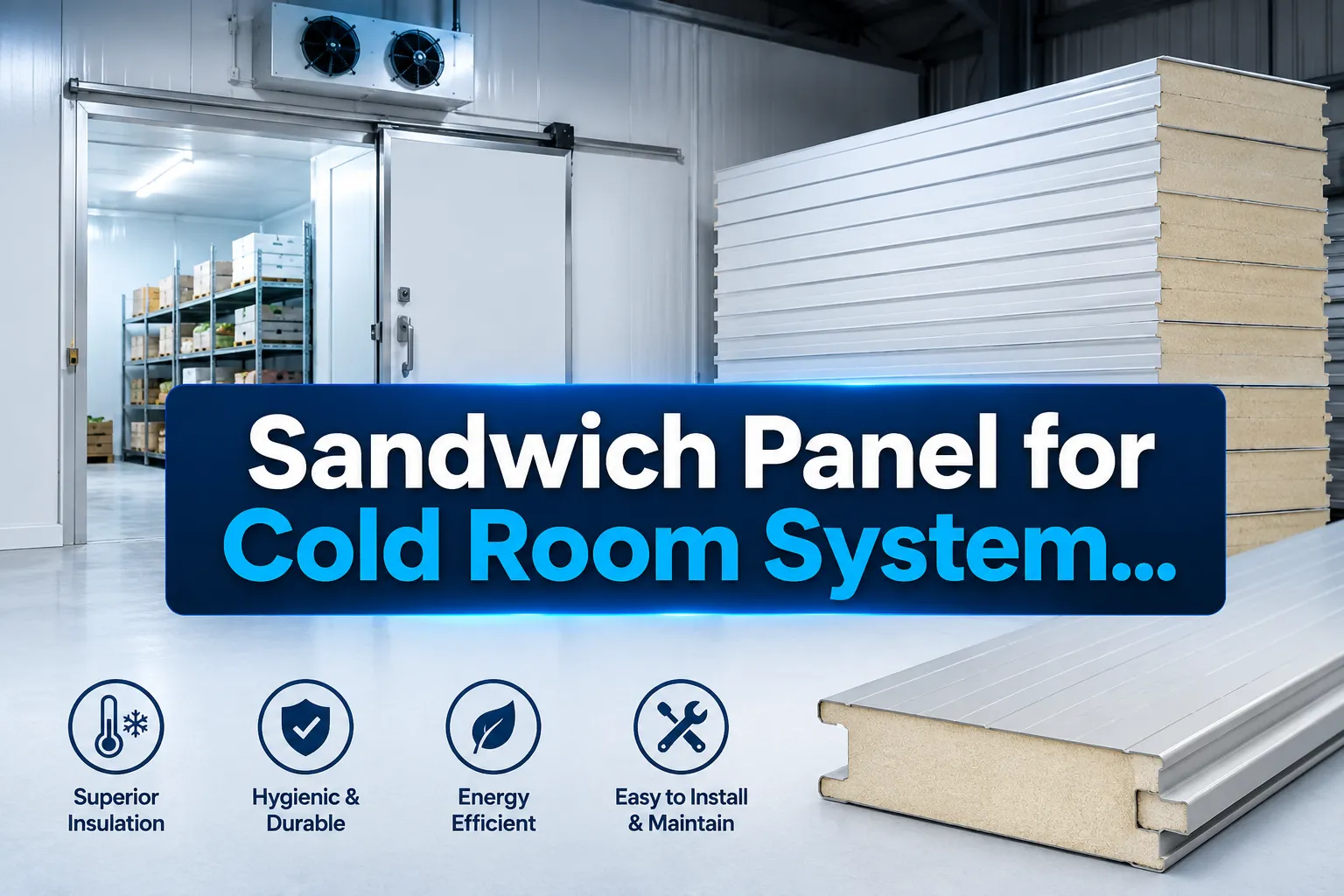
A sandwich panel for cold room system is a prefabricated composite panel consisting of two outer metal skins (typically steel or aluminum) bonded to an insulating foam core. The panel works by creating a continuous thermal barrier that prevents heat transfer while providing structural support for the cold room walls and ceiling.
The science behind sandwich panels lies in their composite construction. The outer metal facings provide structural strength and weather resistance, while the foam core delivers thermal insulation. This design eliminates thermal bridging that occurs with traditional framed construction, where metal studs create pathways for heat transfer.
Key performance characteristics include:
- Thermal conductivity as low as 0.020 W/mK for polyurethane cores
- Compressive strength of 150-300 kPa depending on core density
- Vapor permeability ratings below 1.0 perm for proper moisture control
- Fire resistance ratings from 30 minutes to 2 hours based on core material
Choose sandwich panels over traditional insulation when you need faster installation, better thermal performance, or when dealing with high-humidity environments where moisture control is critical.
Sandwich Panel vs Traditional Insulation for Cold Storage
Sandwich panels outperform traditional insulation methods in cold storage applications through superior thermal efficiency, faster installation, and better moisture control. Traditional stick-frame construction with batt insulation typically achieves R-15 to R-20 per wall assembly, while sandwich panels deliver R-25 to R-40 in the same thickness.
Performance comparison:
| Factor | Sandwich Panels | Traditional Insulation |
|---|---|---|
| Thermal bridging | Eliminated | Significant through studs |
| Installation time | 2-3 days | 7-10 days |
| Air leakage | Minimal with proper sealing | Higher due to multiple joints |
| Moisture resistance | Excellent with closed-cell foam | Variable, depends on vapor barriers |
| Structural integrity | Self-supporting | Requires separate framing |
Traditional insulation works better when you're retrofitting existing buildings, have complex architectural details, or need to accommodate extensive electrical/plumbing runs within walls. The cost difference narrows significantly when factoring in labor savings and energy performance over time.
For new cold room construction, sandwich panels typically reduce total project costs by 15-25% while delivering 20-30% better energy efficiency compared to traditional methods.
How Much Does a Sandwich Panel for Cold Room Cost
Sandwich panel costs for cold room systems range from $8-15 per square foot for materials and $15-25 per square foot installed in 2026. Panel thickness, core material, and facing options significantly impact pricing, with polyurethane cores commanding a 20-40% premium over polystyrene alternatives.
Detailed cost breakdown:
- 50mm EPS panels: $8-10 per sq ft material, $15-18 installed
- 100mm PU panels: $12-15 per sq ft material, $20-25 installed
- 150mm PU panels: $15-18 per sq ft material, $25-30 installed
- Fire-rated panels: Add $2-4 per sq ft premium
- Custom colors/finishes: Add $1-3 per sq ft
Additional project costs include:
- Corner and edge trim: $15-25 per linear foot
- Door frames and hardware: $800-2,500 per opening
- Vapor barriers and sealants: $1-2 per sq ft
- Crane rental for installation: $500-1,500 per day
Budget 10-15% extra for waste and cutting allowances. Projects under 500 square feet often see higher per-unit costs due to minimum order quantities and setup fees. For accurate pricing, get quotes from multiple sandwich panel suppliers as material costs fluctuate with steel and petrochemical prices.
Best Sandwich Panel Thickness for Freezer Rooms
The optimal sandwich panel thickness for freezer rooms is 150mm (6 inches) for most commercial applications, providing R-35 to R-40 thermal resistance needed to maintain temperatures below -10°F efficiently. Thinner panels compromise energy efficiency, while thicker panels offer diminishing returns unless dealing with extreme temperature differentials.
Thickness selection guide:
- 50mm (2"): Suitable only for cooler applications above 32°F
- 75mm (3"): Adequate for short-term cold storage (32-40°F)
- 100mm (4"): Minimum for freezer applications (-10 to 0°F)
- 150mm (6"): Optimal for commercial freezers (-20 to -10°F)
- 200mm (8"): Required for blast freezers below -20°F
Climate considerations matter significantly. In hot, humid climates, increase thickness by 25-50mm to handle higher heat loads and prevent condensation. Cold climates may allow thinner panels due to lower temperature differentials.
The most common mistake is under-insulating to save initial costs. A 100mm panel in a -10°F freezer will consume 30-40% more energy than a 150mm panel, typically paying back the thickness upgrade within 2-3 years through reduced operating costs.
For specific applications, consult our PU sandwich panel guide which covers thickness optimization for different temperature ranges and usage patterns.
Sandwich Panel Installation Problems and Solutions
The most common sandwich panel installation problems include thermal bridging at joints, moisture infiltration, and panel misalignment, which can reduce thermal performance by 20-40% and lead to costly repairs. Proper planning, quality materials, and experienced installers prevent 90% of these issues.
Critical installation challenges and solutions:
Joint sealing failures occur when installers skip vapor barrier tape or use inadequate sealants. Solution: Use manufacturer-approved butyl tape on all joints and apply structural sealant within 4 hours of panel placement before cure begins.
Panel warping and buckling happens with improper support during installation or inadequate fastening. Solution: Support panels every 4 feet during installation and use fasteners rated for thermal cycling, spacing them per manufacturer specifications (typically 12-18 inches on center).
Thermal bridging at connections develops when metal fasteners or structural elements penetrate the insulation layer. Solution: Use thermal break fasteners and minimize penetrations. Where unavoidable, seal penetrations with expanding foam rated for low temperatures.
Moisture accumulation behind panels results from missing vapor barriers or inadequate ventilation. Solution: Install continuous vapor barriers on the warm side and provide ventilation gaps where specified by design.
Common installer mistakes to avoid:
- Installing panels in wet conditions without proper drying time
- Over-tightening fasteners, which compresses insulation and reduces R-value
- Failing to acclimate panels to site temperature before installation
- Mixing panel batches without checking dimensional consistency
Choose installers with specific cold room experience and require them to follow manufacturer installation guidelines. Proper installation typically adds 2-3 days to project schedules but prevents years of performance problems.
Polyurethane vs Polystyrene Sandwich Panels: Which Is Better
Polyurethane (PU) sandwich panels outperform polystyrene (EPS) alternatives in cold room applications due to superior thermal performance, moisture resistance, and structural properties. PU cores deliver R-6 to R-8 per inch compared to R-4 for EPS, making them the preferred choice for commercial freezer applications despite higher upfront costs.
Performance comparison:
| Property | Polyurethane (PU) | Polystyrene (EPS) |
|---|---|---|
| R-value per inch | 6-8 | 3.8-4.2 |
| Moisture absorption | <2% by volume | 3-5% by volume |
| Compressive strength | 25-40 psi | 15-25 psi |
| Temperature range | -40°F to 200°F | -20°F to 160°F |
| Fire resistance | Self-extinguishing | Requires flame retardants |
| Cost premium | 25-40% higher | Baseline |
Choose polyurethane when:
- Operating temperatures below 0°F
- High humidity environments
- Space constraints require maximum insulation efficiency
- Long-term energy savings justify higher initial costs
Choose polystyrene when:
- Budget constraints are primary concern
- Operating temperatures above 32°F
- Lower performance requirements acceptable
- Retrofitting existing structures with thickness limitations
The energy savings from PU panels typically recover the cost premium within 3-5 years in commercial freezer applications. For detailed specifications, see our PU panel cold storage guide which includes lifecycle cost analysis for different core materials.
Sandwich Panels for Cold Rooms: What Size Do You Need
Cold room sandwich panel sizing depends on structural loads, thermal requirements, and installation constraints, with standard widths of 1000mm (39") being optimal for most applications. Panel length should not exceed 12 meters (40 feet) to prevent handling difficulties and thermal expansion issues.
Standard sizing options:
- Width: 1000mm standard, 1200mm for large areas, 600mm for tight spaces
- Length: 2-12 meters in 1-meter increments
- Thickness: 50mm, 75mm, 100mm, 150mm, 200mm standard options
Sizing considerations:
Structural spans determine maximum panel length without intermediate support. For wall applications, 6-meter spans work for most loads. Roof applications typically require support every 4-5 meters depending on snow loads and panel thickness.
Transportation limits often dictate maximum panel size. Standard trucks accommodate 12-meter lengths, while wider panels may require special permits. Coordinate with suppliers early to avoid delivery complications.
Thermal expansion requires 6-12mm gaps between panel ends for temperature cycling. In freezer applications, panels can contract 10-15mm over their length, requiring proper joint design to maintain seals.
Installation efficiency improves with larger panels but requires appropriate lifting equipment. Panels over 8 meters typically need crane installation, adding $500-1,500 daily equipment costs.
Calculate total square footage and add 10% for waste and cutting. For complex layouts, work with manufacturers who offer custom sizing to minimize field cutting and thermal bridging. Our cold room construction guide provides detailed sizing worksheets for different applications.
How Long Do Sandwich Panels Last in Cold Storage
Quality sandwich panels last 20-25 years in cold storage environments with proper installation and maintenance, significantly outperforming traditional insulation systems that typically require replacement every 10-15 years. Panel lifespan depends primarily on core material quality, facing protection, and exposure conditions.
Lifespan factors:
Core material degradation varies by type. Polyurethane cores maintain 90% of thermal performance after 20 years, while lower-grade polystyrene may lose 15-20% efficiency within 10 years due to moisture absorption and thermal cycling.
Metal facing durability determines weather resistance and structural integrity. Galvanized steel facings last 15-20 years in normal conditions, while aluminum or coated steel options extend life to 25-30 years with minimal maintenance.
Environmental conditions significantly impact longevity. Panels in stable freezer environments (-10°F constant) often outlast those in fluctuating cooler applications due to reduced thermal stress and condensation cycles.
Maintenance requirements for maximum lifespan:
- Annual joint seal inspection and repair
- Bi-annual cleaning of drainage systems
- Five-year comprehensive thermal performance assessment
- Immediate repair of any facing damage to prevent moisture infiltration
Warning signs of panel deterioration:
- Increased energy consumption without load changes
- Visible condensation or ice formation on interior surfaces
- Soft spots or deformation in panel faces
- Gaps or separation at panel joints
Budget for major maintenance at 15-year intervals and replacement planning at 20 years. High-quality panels with proper maintenance often exceed 25-year lifespans, making them cost-effective compared to alternative insulation systems requiring more frequent replacement.
Sandwich Panel Cold Room Condensation Issues
Condensation problems in sandwich panel cold rooms result from inadequate vapor barriers, thermal bridging, or improper ventilation design, leading to reduced insulation performance and potential structural damage. Proper vapor barrier installation and joint sealing prevent 95% of condensation issues when combined with appropriate ventilation systems.
Primary condensation causes:
Vapor barrier failures occur at panel joints, penetrations, and connections where warm, humid air contacts cold surfaces. Solution: Install continuous vapor barriers on the warm side with sealed overlaps and use vapor-tight sealants rated for temperature cycling.
Thermal bridging creates cold spots where metal fasteners or structural elements penetrate insulation. These areas become condensation nucleation points. Solution: Use thermal break fasteners and minimize penetrations through the thermal envelope.
Air leakage allows humid air infiltration through gaps in panel systems. Solution: Pressure-test cold rooms to identify leaks and seal with appropriate materials before commissioning.
Prevention strategies:
- Install vapor barriers with perm ratings below 0.1
- Use closed-cell foam sealants at all penetrations
- Provide adequate dehumidification in adjacent spaces
- Design proper drainage for any condensate that does form
- Maintain positive pressure in cold rooms to prevent infiltration
Troubleshooting existing condensation:
- Identify moisture sources using thermal imaging
- Check vapor barrier continuity at all joints
- Verify proper ventilation system operation
- Inspect and repair damaged panel facings immediately
For severe condensation problems, retrofit with additional vapor barriers or upgrade ventilation systems. Our cold room door panel guide covers specific sealing techniques for high-traffic areas where condensation risks are highest.
Who Should Use Sandwich Panels for Cold Room Systems
Sandwich panels work best for commercial food processors, restaurants with walk-in coolers, pharmaceutical companies, and agricultural operations requiring reliable temperature control with minimal maintenance. These systems particularly benefit operations with high energy costs, limited installation time, or stringent hygiene requirements.
Ideal applications:
Food processing facilities benefit from sandwich panels' smooth, cleanable surfaces and superior thermal performance. The seamless construction reduces bacterial harboring points compared to traditional framed walls with multiple joints and crevices.
Pharmaceutical storage requires precise temperature control and validation-friendly construction. Sandwich panels provide consistent thermal performance and documentation needed for regulatory compliance.
Restaurant walk-in coolers need fast installation with minimal disruption. Sandwich panels reduce installation time from weeks to days, allowing faster return to service.
Agricultural cold storage operations benefit from durability and low maintenance requirements. Panels withstand harsh environments while maintaining thermal performance over decades.
Consider alternatives when:
- Budget constraints make upfront costs prohibitive
- Complex architectural details require extensive custom work
- Existing building modifications are more cost-effective
- Local building codes restrict sandwich panel use
Size thresholds for cost-effectiveness:
- Under 200 sq ft: Traditional methods often more economical
- 200-1000 sq ft: Sandwich panels competitive with proper design
- Over 1000 sq ft: Sandwich panels typically provide clear advantages
Evaluate total lifecycle costs including energy consumption, maintenance, and replacement schedules. For specialized applications like poultry processing, see our poultry farm cold room panel guide for industry-specific considerations.
Common Mistakes When Installing Sandwich Panels
The most critical installation mistakes include inadequate joint sealing, improper panel alignment, and insufficient structural support, which can reduce thermal performance by 30-50% and void manufacturer warranties. These errors typically stem from inexperienced installers or rushing installation schedules without proper planning.
Critical mistakes and prevention:
Skipping vapor barrier installation or using incompatible materials leads to moisture infiltration and insulation degradation. Always use manufacturer-specified vapor barriers with sealed overlaps and compatible sealants.
Incorrect fastener selection causes thermal bridging and structural failures. Use only fasteners designed for thermal applications with appropriate length, thermal breaks, and corrosion resistance for the environment.
Poor panel alignment creates gaps that compromise thermal performance and allow air infiltration. Establish reference lines and use proper lifting equipment to maintain alignment during installation.
Inadequate structural support leads to panel deflection, joint separation, and premature failure. Follow structural engineering requirements for spans, loads, and support spacing.
Installation sequence errors:
- Installing panels before completing structural work
- Failing to coordinate with other trades for penetrations
- Not allowing for thermal expansion in joint design
- Installing in unsuitable weather conditions
Quality control checklist:
- Verify panel dimensions and specifications before installation
- Check structural support adequacy and alignment
- Test vapor barrier continuity before closing assemblies
- Document installation with photos for warranty purposes
- Conduct thermal imaging after completion to verify performance
Budget extra time for proper installation rather than rushing to meet deadlines. Poor installation often costs more to repair than doing it correctly initially. For professional installation services, consult our installation service guide which includes contractor vetting and quality assurance procedures.
Sandwich Panel Alternatives for Cold Room Construction
Primary alternatives to sandwich panels for cold room construction include spray foam insulation systems, structural insulated panels (SIPs), and traditional framed construction with batt or rigid foam insulation. Each alternative offers specific advantages depending on project requirements, budget constraints, and performance expectations.
Spray foam systems provide excellent air sealing and thermal performance but require skilled application and proper ventilation during installation. Closed-cell spray foam achieves R-6 per inch, matching polyurethane sandwich panels, but costs 20-30% more for equivalent performance and requires separate structural systems.
Structural insulated panels (SIPs) offer factory-controlled quality similar to sandwich panels but with wood or OSB facings instead of metal. SIPs work well for moderate temperature applications but lack the moisture resistance and cleanability required for commercial food storage.
Traditional framed construction remains cost-effective for small projects or complex geometries. This method allows easier accommodation of utilities and modifications but typically achieves lower thermal performance due to thermal bridging through framing members.
Comparison matrix:
| System | Thermal Performance | Installation Speed | Cost | Durability |
|---|---|---|---|---|
| Sandwich Panels | Excellent | Fast | Medium-High | 20-25 years |
| Spray Foam | Excellent | Medium | High | 15-20 years |
| SIPs | Good | Fast | Medium | 15-20 years |
| Traditional Frame | Fair-Good | Slow | Low-Medium | 10-15 years |
Choose alternatives when:
- Retrofit applications where panel installation is impractical
- Complex architectural requirements exceed panel capabilities
- Local availability or building codes favor other systems
- Budget constraints require lower initial investment
For most new commercial cold room construction, sandwich panels provide the best balance of performance, speed, and long-term value. Consider alternatives primarily when specific project constraints make panels unsuitable.
Sandwich Panel Fire Rating Requirements for Cold Rooms
Commercial cold rooms require sandwich panels with minimum Class A flame spread ratings (25 or less) and smoke development ratings under 450 according to ASTM E84 testing standards. Many jurisdictions also mandate specific fire resistance ratings from 30 minutes to 2 hours depending on building occupancy and cold room size.
Fire rating classifications:
Class A (Class 1): Flame spread 0-25, required for most commercial applications
Class B (Class 2): Flame spread 26-75, acceptable for some industrial uses
Class C (Class 3): Flame spread 76-200, typically not suitable for cold rooms
Core material fire performance:
- Polyurethane: Achieves Class A with flame retardant additives
- Polyisocyanurate: Naturally achieves Class A ratings
- Polystyrene: Requires significant flame retardant treatment
- Mineral wool: Non-combustible, exceeds all requirements
Code compliance requirements vary by:
- Building occupancy classification
- Cold room size and egress distance
- Sprinkler system presence
- Local fire marshal interpretations
Documentation needed for approval:
- ASTM E84 test reports from accredited laboratories
- UL or FM approval listings for complete panel assemblies
- Installation instructions meeting fire-rated assembly requirements
- Field inspection reports verifying proper installation
Specify fire-rated panels early in design since they typically cost $2-4 per square foot more than standard panels and may have longer lead times. For specific fire safety requirements, see our fire-rated panel guide which covers compliance strategies for different building types and jurisdictions.
How to Maintain Sandwich Panels in Freezer Environments
Proper maintenance of sandwich panels in freezer environments requires quarterly inspections, annual seal replacement, and immediate repair of any damage to prevent moisture infiltration and thermal degradation. Preventive maintenance programs extend panel life by 30-40% while maintaining optimal energy efficiency throughout the system's lifespan.
Quarterly maintenance tasks:
- Inspect all panel joints for gaps or seal deterioration
- Check for ice buildup or condensation indicating thermal bridging
- Examine panel faces for dents, scratches, or corrosion
- Verify door seals and hardware operation
- Clean drainage systems and condensate removal equipment
Annual maintenance requirements:
- Replace weatherstripping and joint sealants showing wear
- Conduct thermal imaging survey to identify performance degradation
- Inspect and tighten all fasteners affected by thermal cycling
- Clean panel surfaces with approved cleaners for food-grade environments
- Document energy consumption trends to identify efficiency changes
Immediate repair priorities:
- Any penetration or damage to panel facings
- Separated joints allowing air infiltration
- Ice formation on interior surfaces
- Damaged vapor barriers or insulation exposure
Maintenance cost planning:
Budget $0.50-1.00 per square foot annually for routine maintenance, with major seal replacement every 5-7 years adding $2-3 per square foot. Deferred maintenance often costs 3-5 times more to correct than preventive care.
Environmental considerations:
Use only cleaners and sealants rated for food contact surfaces and low-temperature applications. Many standard construction sealants become brittle in freezer environments, leading to premature failure.
Establish maintenance schedules during installation and train facility staff on proper inspection techniques. For comprehensive maintenance programs, consult our sandwich panel warranty guide which includes manufacturer-approved maintenance procedures and warranty protection strategies.
Frequently Asked Questions
What is the minimum thickness for a freezer room sandwich panel?
The minimum thickness for freezer applications is 100mm (4 inches), but 150mm (6 inches) is recommended for commercial freezers operating below -10°F to achieve adequate thermal performance and energy efficiency.
Can sandwich panels be used for blast freezer applications?
Yes, but blast freezers require 200mm thick panels with polyurethane cores and enhanced vapor barriers due to extreme temperature differentials and rapid temperature changes that create higher thermal stress.
How do you cut sandwich panels without damaging the insulation?
Use a circular saw with a fine-tooth blade for metal facings and immediately seal cut edges with expanding foam and aluminum tape to prevent moisture infiltration and maintain thermal integrity.
Are sandwich panels food-safe for direct food contact areas?
Sandwich panels with smooth, non-porous metal facings meet food safety requirements when properly sealed, but direct food contact surfaces should use stainless steel facings rather than painted steel options.
What happens if moisture gets into sandwich panel cores?
Moisture infiltration reduces insulation performance by 20-40% and can cause core degradation, panel swelling, and potential mold growth, requiring immediate repair or panel replacement to restore performance.
Can existing cold rooms be retrofitted with sandwich panels?
Retrofitting is possible but often requires structural modifications to accommodate panel dimensions and loads, making it less cost-effective than new construction in most cases.
Do sandwich panels require special electrical considerations?
Electrical penetrations must use thermal break fittings and proper sealing to prevent thermal bridging, and all wiring should be planned before installation to minimize core penetrations.
How do sandwich panels perform in high-humidity environments?
Properly installed sandwich panels with continuous vapor barriers perform excellently in high humidity, but inadequate sealing can lead to condensation problems requiring immediate correction.
What warranty coverage is typical for cold room sandwich panels?
Standard warranties cover 10-15 years for thermal performance and 5-10 years for facing materials, with extended coverage available for premium products and proper maintenance compliance.
Can sandwich panels support equipment mounted on walls?
Yes, but mounting requires proper backing plates and fasteners designed for thermal applications, with load calculations verified by structural engineers for heavy equipment installations.
How do you repair damaged sandwich panel sections?
Small damage can be repaired with patch panels and sealants, but significant damage typically requires full panel replacement to maintain thermal integrity and warranty coverage.
Are there special requirements for seismic areas?
Seismic installations require flexible connections and enhanced fastening systems designed to accommodate building movement while maintaining thermal envelope integrity during seismic events.
Conclusion
Sandwich panels represent the most efficient and cost-effective solution for modern cold room construction, delivering superior thermal performance, faster installation, and lower lifecycle costs compared to traditional insulation methods. The key to success lies in proper material selection, professional installation, and consistent maintenance practices.
For optimal results, specify polyurethane core panels with minimum 150mm thickness for freezer applications, ensure proper vapor barrier installation, and work with experienced installers familiar with cold storage requirements. The higher upfront investment typically pays back within 3-5 years through reduced energy costs and maintenance requirements.
Next steps for your cold room project:
- Assess your specific requirements including temperature range, size, and performance expectations
- Get quotes from multiple suppliers to compare materials, installation services, and warranty terms
- Verify local building codes and fire rating requirements before finalizing specifications
- Plan for professional installation with experienced contractors who understand cold storage applications
- Establish maintenance programs from day one to protect your investment and maintain optimal performance
The cold storage industry continues evolving toward more efficient, sustainable solutions. Sandwich panels provide the foundation for meeting these challenges while delivering reliable temperature control for years to come.
SEO Meta Title: Sandwich Panel for Cold Room System: Complete 2026 Guide